Category: Richland Parish Data Center

  • The Overlap: Public Dollars, Private Influence

    The Overlap: Public Dollars, Private Influence

    This article may appear in multiple series, as the topics are intertwined.

    Economic development in Northeast Louisiana is often described as a public-private partnership. That model is common. What matters is how it functions in practice.

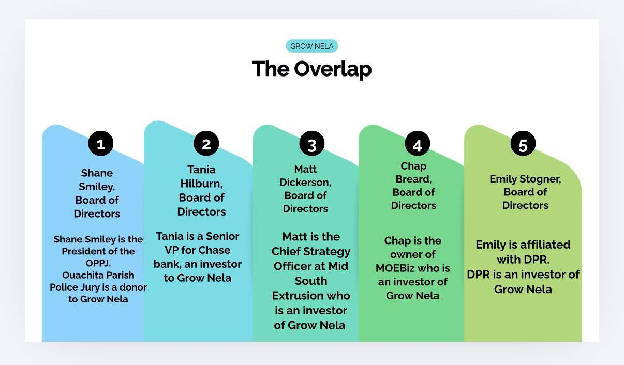
    A review of GROW NELA’s publicly listed Board of Directors and investor roster reveals a pattern of overlap between those who financially support the organization and those who help govern it.

    Documented examples include but are not limited to:
    Shane Smiley, President of the Ouachita Parish Police Jury. The Police Jury is listed as an investor in GROW NELA. Smiley also serves on GROW NELA’s Board of Directors representing the parish.
    Tania Hilburn, Senior Vice President with Chase Bank. Chase is listed as an investor in GROW NELA. She serves on the board representing the bank.
    Matt Dickerson, Chief Strategy Officer at Mid South Extrusion. Mid South Extrusion is listed as an investor in GROW NELA. He serves on the board.
    Chap Breard, owner of MOEbiz. MOEbiz is listed as an investor in GROW NELA. He serves on the board.
    Emily Stogner, affiliated with DPR Construction. DPR is listed as an investor in GROW NELA. DPR is also a prime contractor on the Meta data center project in Richland Parish.

    These connections are drawn directly from publicly available board and investor listings.

    This structure means that multiple entities financially supporting GROW NELA also hold governance positions within the organization.

    That structure is not automatically improper.

    However, when public institutions invest taxpayer dollars into an organization whose board includes private firms that may later benefit from development projects, the public has a right to review:
    – How funding agreements are structured
    – Whether conflicts of interest are disclosed
    – Whether recusals are documented
    – Whether procurement processes involving investor-linked firms are transparent

    Public Records Requests

    In order to better understand how these relationships operate in practice, I submitted public records requests to both the City of Monroe and the Ouachita Parish Police Jury seeking documentation of:
    – Contracts and cooperative agreements with GROW NELA
    – Payments to investor-linked firms
    – Procurement documentation related to those contracts

    After receiving no communication from the Police Jury, I visited their office in person. I was informed that my request was received on February 20. I requested written confirmation of receipt and was told the request had been forwarded to the Police Jury’s attorney.

    As of this writing, no records have been produced.

    Under Louisiana Public Records Law, public bodies are required to respond within three business days by either producing records or providing a written explanation and timeline.

    The State of Louisiana has acknowledged receipt of a related records request and indicated that documents are being compiled on their behalf.

    This review is ongoing.
    CAN Report Image

  • Consumer Groups Sound Alarm After Louisiana PSC Declines to Investigate

    Series: The Richland Parish Data Center

    Consumer advocacy organizations are raising serious concerns after the Louisiana Public Service Commission (PSC) declined to investigate a complex financing arrangement tied to Meta’s $27 billion data center project in Richland Parish.

    According to a press release issued this week, Earthjustice, the Alliance for Affordable Energy, and the Union of Concerned Scientists had requested that the PSC examine what they describe as a “risky” financial restructuring involving Meta and Blue Owl Capital.

    Here’s the concern:

    Originally, the PSC approved Entergy Louisiana’s plan to build three new gas plants and related transmission infrastructure to power Meta’s data center. That approval was based on financial assurances that were intended to protect ratepayers from long-term risk.

    However, on the same day that approval was granted in August 2025, Meta reportedly restructured the deal. Through a joint venture with Blue Owl Capital, Meta reduced its ownership stake in the data center’s holding company to 20%. The new entity borrowed $27 billion to finance the project.

    Consumer groups argue this restructuring allows Meta to walk away from the project after just four years under its lease agreement, while the gas plants being built to power the facility are designed to operate for 30 years.

    If the data center closes early, advocates warn that Louisiana ratepayers could be left responsible for the remaining costs of the fossil-fuel infrastructure. In addition, more than half a billion dollars in transmission costs tied to the project will reportedly be spread across Entergy customers once construction is complete.

    The motion filed in January asked the PSC to conduct a prudence review and investigate whether Entergy was aware of the financial restructuring prior to the August vote. The Commission declined to take up the request.

    Consumer groups say the decision denies the public an opportunity to fully examine how this financing structure could impact household utility bills. They argue regulators have a responsibility to reassess projects when major financial terms change.

    Supporters of the project, meanwhile, have pointed to economic growth, construction jobs, and tax revenue associated with the data center buildout.

    The broader question now facing Louisiana residents is this:
    Who ultimately bears the long-term financial risk if the structure of the deal changes?

    As this project moves forward, transparency and accountability remain at the center of the debate.

  • Important Update: Attorney Robby Dube

    Series: The Richland Parish Data Center

    Meet Attorney Robby Dube:

    During my investigation into the Data Center, I came across some information that was very concerning to me. It brought my investigative series to a pause. For now, I am leaving it on pause for good reason. Please read this in its entirety before asking questions. We are not just dealing with Richland Parish anymore. Caddo Parish announced their Amazon data center and believe me, more are coming across Louisiana. Many mega companies are looking to take root here in our state and we will soon be looking at massive industrial plants across the region.

    1. To those that support the data centers being built, this is not targeted toward you. I support your right to enjoy the benefits of these data centers, and I am glad your voice and opinion has been heard.
    2. To those who do not support the data centers, I am concerned with you about your inability to vote and decide on these issues as a community. So many people feel left out of the decision making, powerless to these changes, and scared of what is coming.

    In the past few weeks, I have been in conversations with attorney Robert Dube of Eckland & Blando. He is a very experienced attorney in Minnesota whose practice is centered on constitutional law, government and administrative litigation and more. He is licensed to practice in federal court and has experience in these specific issues.

    The Community Accountability Network is here to offer an opportunity to the group of individuals who feel they have no voice in these changes by representing you alongside attorney Dube.

    I want to be clear:
    Exploring legal options is not about dismissing or diminishing the views of the community who supports the data centers. Our goal is to continue to give a voice to everyone in the community and right now many people feel silenced and pushed out of their own land. Our only goal is to make sure that everything being introduced to Louisiana is being done in the light, that citizens have access to ALL the information they are entitled to and we trust the legal system to make that determination for you all.

    In the coming days, we will be announcing a meeting open to the public where more information will be available regarding this opportunity.

    We want to hear from you so please take the coming days to gather your thoughts, write down your questions and feel free to speak with us at the coming meeting.

    The only thing I am asking at this point is that you share this post so that everyone has a chance to be heard — both those who agree and disagree. The local agencies may not have handled the changes this way, but we will. The community is entitled to making informed decisions together with transparent information.

    This is your opportunity to move forward with clarity and unity — the way it should have been in the beginning.

    Event link: Attorney Dube Q&A

  • Bonus Feature: The Digital Footprint (Chart 2)

    Bonus Feature: The Digital Footprint (Chart 2)

    Series: The Richland Parish Data Center: Truth, Rumor & The Record

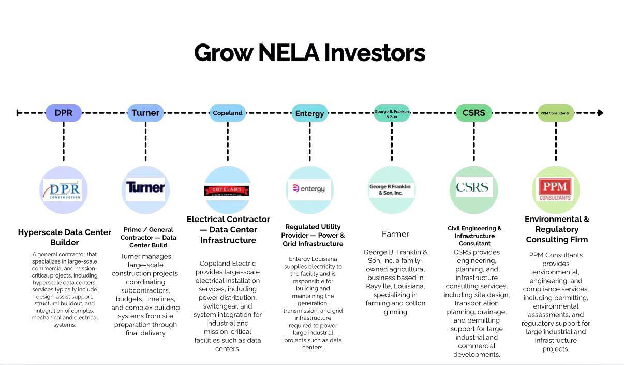
    This graphic is the first in a bonus series breaking down the structure behind the Richland Parish Data Center project.

    To be clear: this is not an accusation of wrongdoing. It is an informational overview of investors who have the closest structural proximity to the construction and infrastructure layers of the project.

    This chart focuses on companies whose industry roles align directly with large-scale industrial builds — including prime contractors, heavy civil construction, electrical infrastructure, engineering, and utility providers. These categories are typically involved in site preparation, power delivery, construction management, permitting, and systems integration.

    The purpose is to explain how large projects like this are built and which sectors are positioned within that execution ecosystem. Investor status does not automatically mean a company was awarded a contract or had decision-making authority. It simply shows financial participation in the regional economic development organization alongside industry alignment.

    As I continue reviewing public documents and awaiting responses to records requests, future charts will explore additional layers — including timeline, governance structure, and broader economic impact.

    The goal is transparency and understanding of process, not speculation.

    More information to come.

    CAN Report Image

  • Bonus Feature: The Digital Footprint (Chart 1)

    Bonus Feature: The Digital Footprint (Chart 1)

    Series: The Richland Parish Data Center: Truth, Rumor and The Record

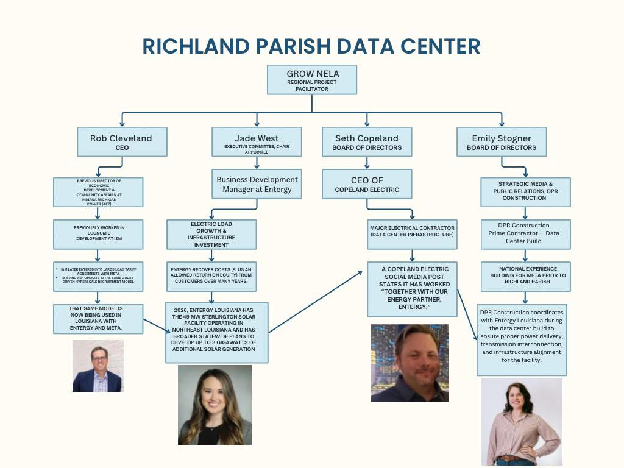
    Remember these names, remember these faces — this is one of many charts I’ll be dropping just to fill you in on the connections that deserve clarity.

    It simply maps out publicly documented roles connected to the Richland Parish Data Center: regional economic development (Grow NELA), the utility provider (Entergy), and contractors involved in the build (DPR and Copeland Electric). These kinds of projects typically move through recruitment, infrastructure planning, and regulatory approval before public announcement, often within a relatively small professional network.

    The purpose of this graphic is to show structure — not to suggest wrongdoing. Many citizens have said they felt left out of the loop, so I’m laying the groundwork to better understand how the process unfolded. I’m still waiting on public records requests, and future posts will include more documentation as it becomes available.

    CAN Report Image

  • Update: Waiting on Public Records

    Series: The Richland Parish Data Center: Truth, Rumor & The Record

    I want to address the delay in publishing the next installment of this series.

    Multiple public records requests have been submitted to local entities regarding board minutes, confidentiality agreements, legal expenditures, and related documentation connected to the Meta project. As of today, local agencies have not provided responses within the expected timeframe.

    The State of Louisiana is currently the only office that has formally acknowledged receipt of my request and is actively assisting in locating records. That process is underway.

    I have also reached out directly to several officials for comment. Mayor Friday Ellis responded and his responses were published. Shane Smiley has not responded to requests for comment as of publication. As fate would have it, I did see him in person last week at the Daily Press in Monroe. I reminded him of my requests for transparency and was told he would follow up, but I have not yet received a response. The mayor’s office in Rayville has also not returned my calls.

    In addition, individuals with legal authority have contacted me requesting meetings regarding what I have uncovered so far. I welcome open dialogue grounded in documentation. I am looking forward to these meetings.

    Let me be clear: this reporting is not driven by rumor. It is driven by records. The next article is delayed because I am waiting on documentation. Responsible reporting requires verification, not assumptions.

    This story is not being abandoned. It is being built carefully.

    Major projects leave paper trails. When those records are received and reviewed, I will publish. Taking what I’ve learned off the record and putting it into a responsible article takes time.

    I planned my timelines for publishing around the length of time public records requests operate on — lesson learned.

    Stay patient. It’s still coming.

  • Part 6 — The Local Layer (1 of 2): What We Know Now

    Series: The Richland Parish Data Center: Truth, Rumor & The Record

    As I continue examining the local layer behind the arrival of Meta to northeast Louisiana, I want to begin by clearly separating what is documented and confirmed from what remains under review.

    Major projects like this do not move forward through corporations alone. They move through regional boards, nonprofits, utilities, chambers of commerce, and public officials who operate much closer to home. Understanding that local layer is essential.

    Confirmed Board Overlap

    Public nonprofit filings show that both Friday Ellis and Shane Smiley served on the board of Grow NELA during the period when the Meta data center was being promoted. Grow NELA later transitioned into Grow Northeast Louisiana, with overlapping leadership involved in that restructuring.

    It is also documented that during this period, the nonprofit reported significant legal and consulting expenditures and later transferred assets as part of its transition.

    Those facts are not allegations. They are contained in publicly filed nonprofit documents.

    Entergy Representation

    Board listings also show representation connected to Entergy, the regional electric utility. That is not unusual for economic development organizations. Utilities frequently sit on regional boards because infrastructure and power commitments are central to industrial recruitment.

    However, it is a relevant structural detail given that hyperscale data centers like Meta’s are heavily dependent on long-term power agreements and grid capacity planning.

    Richland Parish Chamber Overlap

    There is also documented overlap between Grow NELA board membership and the Richland Parish Chamber of Commerce. Chamber leadership participation in regional development boards is common, but it is part of the broader ecosystem that shaped regional economic strategy during the same timeframe.

    These overlapping roles do not imply wrongdoing. They do, however, illustrate how interconnected regional leadership can be during major project development.

    Direct Questions to Local Officials

    Because of public speculation surrounding non-disclosure agreements and local involvement, I reached out directly to Mayor Ellis and to Shane Smiley for comment and clarification on the rumors circling.

    Mayor Ellis responded.

    In his response, he stated that he did not personally sign any non-disclosure agreement related to Meta, site selection, or economic development discussions. He also stated that the City of Monroe did not sign any non-disclosure agreements related to the project.

    Ellis acknowledged that confidentiality agreements are common during early site evaluation processes but stated that any such agreements would have been handled at the organizational level and that he was not a signatory.

    He further stated that he did not participate in Meta site selection negotiations and was not involved in Meta-related discussions at either the city level or within the nonprofit. He described his board role as general governance and regional economic development strategy rather than project-level negotiation.

    As of publication, Shane Smiley has not responded to a request for comment regarding the same questions.

    I also reached out to the Mayor of Rayville for comment. That call has not been returned.

    What Happens Next

    Public records requests have been submitted seeking:
    – Board meeting minutes
    – Confidentiality agreements
    – Legal expenditure documentation

    Those records are pending.

    Part Two of The Local Layer will move beyond board structure and governance and examine another critical piece of the story: how the land for the Meta project was acquired and what can be expected moving forward in terms of land purchasing, development expansion, and regional real estate impact.

    When projects of this scale arrive, the story is not just about a corporation. It is about the network of local leadership, institutions, infrastructure partners, and property decisions that shape what happens next.

    This first installment focuses on what is documented and confirmed.

    The next will examine the land, the transactions, what they may signal about the future and what the pending records can confirm.

  • Bonus Feature: Pressure Below the Surface

    Series: The Richland Parish Data Center: Truth, Rumor and The Record

    This is perhaps the most concerning portion of my research. While topics like corruption and the money trail interest many people, sometimes we get lost in the conspiracies and forget to face the realities of what real-life consequences exist beyond the deep pockets behind the scenes.

    This article is based on historical events from North Louisiana and the real risks involved in the data center’s construction. As of publication of this article, Meta has not responded, but I did send a request to their environmental team to get a better understanding of their potential awareness (or lack thereof) regarding this risk. This article will be long.

    Many people in Richland Parish may not realize that long before data centers, industrial expansion, or modern development, our area played a major role in Louisiana’s oil history. Communities like Delhi, Holly Ridge, and Dunn sit above what is known as the Delhi Field, an oil field that was heavily developed during World War II and reshaped the land beneath our feet in ways that still matter today.

    During the war, oil was considered a strategic national resource. Wells in the Delhi Field were drilled quickly and in large numbers to meet urgent demand. While that effort supported the country at the time, it also left behind aging infrastructure, legacy wells, and underground formations that have been altered by decades of industrial activity.

    Years later, the field became known for a process called CO2-enhanced oil recovery. This method involves injecting pressurized carbon dioxide underground to help push oil out of older wells. It is a common practice in aging oil fields and was used extensively in the Delhi Field by operators such as Denbury Resources, which was later acquired by ExxonMobil.

    This history is important because carbon dioxide does not simply disappear after injection. It remains underground, contained by rock layers, well casings, and pressure balance. When those systems work as designed, the gas stays put. When they fail, problems can occur.

    In the Delhi Field, there is a documented example of this. At the Holt-Bryant Unit, a well failure allowed oil, saltwater, and carbon dioxide to reach the surface. The incident required an extended environmental cleanup and a HAZMAT response, along with temporary restrictions in the area. This event matters because it shows that surface releases are not just theoretical. They have happened here before.

    Carbon dioxide is not toxic in the traditional sense, but it can be dangerous when released in large amounts. It is colorless, odorless, and heavier than air. When it escapes into low-lying areas, it can displace oxygen, creating risks for people, animals, and vegetation without obvious warning signs. That is why carbon dioxide releases are treated as environmental and safety emergencies and why they trigger specialized response protocols.

    Today, the conversation has shifted to large-scale development, including data centers, which require significant water resources to operate. Groundwater withdrawal itself is not unusual, but in areas with complex underground histories, it raises reasonable questions. Large changes in water levels can affect underground pressure, and pressure balance is one of the factors that helps keep gases and fluids contained deep below the surface.

    This does not mean that a problem will occur. It means that history matters when evaluating risk. Areas with porous formations, legacy wells, and past carbon dioxide injection deserve careful study and clear communication about safeguards, monitoring, and contingency planning.

    To better understand how these issues were evaluated, Meta has been contacted with questions about groundwater modeling, subsurface pressure considerations, legacy well integrity, and which agencies reviewed and approved those assessments. As of publication, a response has not yet been provided.

    Asking these questions is not about stopping development or spreading fear. It is about transparency. Communities deserve to understand what exists beneath their land, what has happened here before, and how those lessons are being applied today. Growth and accountability are not opposites. They work best when the public is informed and included.

    This article is meant to provide context, not conclusions. The goal is clarity, not alarm. History does not automatically dictate the future, but ignoring it has consequences. Understanding it gives communities the ability to ask better questions and make more informed decisions about what comes next.

    TLDR:
    This article explains the industrial history beneath parts of Richland Parish, where oil drilling and carbon dioxide (CO2) injection were used for decades in the Delhi Field. A past well failure in the area shows that oil, saltwater, and CO2 have reached the surface before, which is why CO2 is treated as a safety concern when it escapes underground. With new large-scale development requiring significant water use, the article asks whether this history was fully considered and what safeguards are in place. The goal is transparency and public understanding, not alarm.

    I will provide additional context and information in my final part of the series when I talk more freely in an opinion piece. If you’ve stuck around this long, thank you.

  • Part 5 — Inside the Black Box

    Series: The Richland Parish Data Center: Truth, Rumor & the Record

    When concerns are raised about projects like Meta’s data center, most people assume any problems would come from the corporation itself. That wouldn’t shock anyone.

    What would be surprising is if the most important questions sit much closer to home.

    Across the country, the same three construction giants frequently appear in hyperscale data center projects: DPR Construction, M.A. Mortenson, and Turner Construction. These companies have the experience and scale required to build massive facilities like Meta’s, but they also bring history with them.

    In other states, these firms have been connected to serious controversies on large public projects, including bid rigging allegations, procurement violations, and pay-to-play schemes involving public officials. Those cases did not happen here, and they do not prove wrongdoing in Richland Parish. But they show something important. When billions of dollars are involved, corruption rarely looks obvious.

    It usually does not show up as a direct bribe or a single bad decision. Instead, it moves quietly through consultants, legal contracts, site readiness work, nonprofits, utilities, and early planning phases that happen long before the public is informed or invited to ask questions.

    That context matters locally because the Meta data center required:
    – Extensive infrastructure
    – Massive power commitments
    – Coordination with utilities
    – Economic development advocacy
    – Legal structuring and approvals

    Many of those decisions happen behind the scenes, not at ribbon cuttings.

    This is not about assuming guilt. It is about understanding patterns that have played out elsewhere and asking whether strong safeguards, transparency, and independent oversight existed here.

    In my next piece, I will be looking at whether any of those same money pathways show up in local records connected to this project.

    If everything was done above board, the paper trail should make that clear.
    If not, the records will tell that story too.

  • Part 4 — The New Smoke Stack

    Series: The Richland Parish Data Center: Truth, Rumor, and the Record

    As data centers continue expanding across rural and residential parts of the country, they are often described as clean, quiet, and low-impact. But when these facilities arrive in regions like North Louisiana, they are not entering a blank slate. They are being layered onto communities that already experience some of the highest rates of chronic illness in the state and the nation. Understanding the environmental and health implications of data centers requires looking not just at what they add, but at what already exists.

    North Louisiana has long struggled with elevated rates of respiratory disease. Asthma and chronic obstructive pulmonary disease are more common here than in many parts of the country, and these conditions are known to worsen with exposure to air pollution, especially fine particulate matter and nitrogen oxides. These pollutants are associated with industrial activity, fossil-fuel power generation, and diesel emissions — all of which are connected to the energy demands of large-scale data centers. Even when facilities operate without outages, backup diesel generators are routinely tested, releasing concentrated bursts of pollution into surrounding areas. For residents already living with respiratory vulnerability, these emissions can compound existing health risks over time.

    Cancer is another major concern. Louisiana has one of the highest cancer mortality rates in the United States, and while the most well-known industrial pollution corridor lies in the southern part of the state, northern parishes are not immune to cumulative exposure. Long-term contact with air and water contaminants, even at low levels, has been linked in scientific literature to increased cancer risk. Many North Louisiana communities already live near industrial plants, rail corridors, and power infrastructure. Adding another energy-intensive operation raises concerns not because of a single source, but because of layered exposure that builds over decades.

    Heart disease and stroke are the leading causes of death in Louisiana, and North Louisiana follows this trend closely. Medical research has established a strong connection between air pollution and cardiovascular illness, including heart attacks and strokes. Fine particulate matter can enter the bloodstream through the lungs, increasing inflammation and stress on the cardiovascular system. When regions with high baseline rates of heart disease experience additional pollution burdens, the public health consequences can be significant, even if those changes are gradual and difficult to trace to one source.

    Water use presents another critical issue. Data centers require enormous volumes of water to cool servers and maintain operations. In rural North Louisiana, many residents rely on groundwater and wells rather than large municipal systems. Heavy industrial water withdrawal can lower water tables, strain aquifers, and affect water quality. Communities elsewhere have reported declining well levels and water access challenges after large facilities began operating nearby. In a region where clean, reliable water is already essential to public health, increased competition for water resources raises serious concerns.

    These environmental pressures do not occur evenly across populations. Low-income and rural communities often bear a disproportionate share of industrial impacts, including poorer air quality and reduced access to healthcare. North Louisiana already faces challenges related to chronic disease, maternal and infant health outcomes, and access to medical services. Research shows that air pollution exposure is linked to higher rates of low birth weight, premature birth, and other adverse outcomes. While no single facility can be blamed for these trends, cumulative environmental stress plays a recognized role in worsening health disparities.

    None of this suggests that data centers alone are responsible for North Louisiana’s health challenges. Smoking rates, diet, genetics, and socioeconomic factors all play important roles. But public health experts consistently emphasize that environmental exposures interact with these factors, amplifying risk rather than existing in isolation. When communities already facing high rates of asthma, cancer, heart disease, and stroke are asked to absorb additional industrial load, it is reasonable to ask how much more the system can bear.

    The conversation around data centers is often framed as a choice between economic growth and opposition to progress. That framing misses the point. The real issue is whether communities are being given a full picture of how these facilities affect air quality, water resources, and long-term health in regions already carrying heavy environmental and medical burdens. Digital infrastructure may be invisible to the eye, but its physical footprint is real, measurable, and felt most by the people living closest to it.

    As North Louisiana continues to be considered for large-scale industrial and digital development, the question is not whether technology should exist, but whether growth is being planned with the health of existing communities at the center of the conversation, rather than treated as an afterthought once construction is complete.

    Health data shows us the consequences. Money records show us the motivations. In the next article, Inside The Black Box, I’ll be examining the financial trail behind data center development and asking why so many key decisions affecting public resources were made behind closed doors.

    TLDR:
    North Louisiana already faces high rates of asthma, cancer, heart disease, and stroke. Large data centers add significant demands on electricity and water, contributing to air pollution and resource strain that can worsen existing health vulnerabilities. While no single facility can be blamed for these conditions, layering energy-intensive infrastructure onto communities with known health challenges raises serious concerns about cumulative environmental exposure and long-term public health. Communities deserve transparency and health-centered planning before additional industrial impacts are introduced.