Tag: Education

  • Downsville Demons — Part 2

    Sheriff Gates Stands by Investigation as Allegations Surface at Downsville Charter

    Union Parish Sheriff Dusty Gates says he stands by the work of his investigators following a recent case connected to Downsville Community Charter School.

    In a recent meeting, Sheriff Gates told me that his investigators conducted a thorough investigation into the matter and handled it appropriately. Gates also stated that he personally disagrees with the District Attorney’s decision in the case but continues to support the work carried out by his department.

    The case has drawn increased attention to the school and its leadership, prompting a number of parents, former students, and community members to reach out with their own concerns regarding Downsville Community Charter School and its Executive Director, Tony Cain.

    Over the past several months, numerous individuals have contacted me describing their experiences at the school. The concerns shared fall into several general categories, including discipline practices, handling of bullying complaints, student search procedures, treatment of students with IEPs and 504 plans, and communication with parents during disciplinary matters.

    Some individuals also described incidents they believe involved extreme, inappropriate and excessive discipline or force, while others reported concerns about how complaints were handled by school administration. At this stage, these accounts remain allegations shared by individuals who reached out directly.

    I have spoken with Mr. Cain regarding these concerns and provided him with the general areas of inquiry. Mr. Cain provided a written response addressing school policies related to discipline, bullying procedures, student searches, and school governance. His full response will be published in Part Three so readers can review his explanation in full.

    In addition to gathering accounts from parents and former students, public records requests have been submitted to the Louisiana Department of Education seeking documentation related to governance records, board actions, contract renewals, and bylaw amendments at the school as I have concerns about the way the school has been structured.

    This article is Part Two of an ongoing review. Future reporting will focus on documented records, school policies, and responses from school leadership.

    My opinion:
    I have reviewed over twenty-five accounts of serious allegations against Mr. Cain. I am personally very concerned about the criminal charges being dropped, the case being silenced and the allegations continuing thereafter. I have reviewed the evidence in the case, and while I am not a lawyer, I find myself very concerned at the decision to not move forward through the proper legal channels on this matter.

    I will be reaching out to the DA/Judge’s office to request a meeting to discuss these concerns. When a Sheriff’s office feels confident in their work and investigation and are left with the same concerns as the citizens, that indicates a lack of transparency somewhere along the line.

    Anyone with documentation related to these matters may contact me privately at [email protected].

  • Downsville Demons — Part 1

    Serious Concerns Raised About Downsville Charter School

    I’ve received multiple messages from parents raising serious concerns about Downsville Charter School, including allegations of excessive corporal punishment, dismissed bullying complaints, and administrative responses they say have harmed students.

    Parents allege that when students report bullying, they are often told they are “tattling,” dismissed, or instructed to be quiet. When parents attempt to advocate for their children, they say concerns are deflected or placed back on the child. Several families describe a pattern in which unresolved bullying escalates until a child reacts, resulting in disciplinary action against the student rather than addressing the original complaint. Some parents also allege the school has been quick to suggest having children admitted for evaluation instead of addressing underlying issues.

    One of the most serious accounts shared with me involves an 11-year-old student with a Section 504 designation. According to my source, the student was removed from class following activity on a school computer and taken to the office by staff identified as Tony Cain and another staff member referred to as Mr. Bean. The parent alleges Mr. Cain authorized and carried out corporal punishment using a plastic paddle, resulting in broken skin and severe bruising. Photos provided to me appear to show extensive bruising. Corporal punishment of students with Section 504 protections is prohibited under state and federal law.

    According to the account, the Union Parish Sheriff’s Department investigated the incident and confiscated the paddle. No criminal charges have been filed at this time. Following the incident, the school board reportedly implemented a policy prohibiting corporal punishment.

    This is an ongoing story. I did reach out to the school for an interview, but as of the date of this publication have not yet received an official response.

    If you are a parent, student, or staff member with relevant information or experiences involving Downsville Charter School and would like to share them, you can contact me privately. Information can be shared safely and anonymously, and identities will not be published without consent.

    I will continue to update as more information becomes available.

  • Ouachita Parish Fire Department — Chief Robert Moore Interview

    In a sit-down interview, Robert Moore, Fire Chief of the Ouachita Parish Fire Department, said the department’s mission is simple: to serve the public and meet community needs.

    “We’re here to help,” Moore said. “I just don’t think people realize everything we do.”

    Many residents only interact with the fire department during emergencies, but Chief Moore says the department provides far more services than most people realize. He has served with the department for nearly 15 years and brings more than 35 years of public safety experience to the role.

    Ouachita Parish operates as one unified fire district, covering nearly the entire parish outside of Monroe and West Monroe. Unlike many areas in Louisiana that rely on small volunteer districts, Ouachita Parish runs as a coordinated system with 15 fire stations, with a 16th station planned along Highway 80 near Trapp Field, currently projected for 2028.

    While fire suppression is a core responsibility, about 80% of calls are medical. Many firefighters are paramedic-certified and provide advanced life support, often arriving before ambulance services. The department is also the only local agency with mechanical CPR devices on every frontline truck, allowing consistent chest compressions during cardiac arrest and transport — a critical factor in survival, especially in rural areas.

    Despite covering more than 600 square miles, the department holds a Class 3 fire rating, considered exceptional for a district of this size and one that can positively affect insurance rates. Moore says the department plans years in advance for major purchases like fire engines, ladder trucks, and stations, allowing them to operate without debt or bonds and stay within budget.

    The department also offers several free services many residents don’t know about, including free smoke alarm installation, fire safety education in schools, CPR and first responder medical training, fire protection reviews for new subdivisions, and assistance with gas or carbon monoxide concerns. If a request falls outside their jurisdiction, staff help connect residents with the appropriate agency.

    Ouachita Parish Fire Department maintains an Urban Search and Rescue team and is part of a regional response network activated through the Louisiana State Fire Marshal. Local firefighters have deployed to floods, hurricanes, and other disasters both in Louisiana and out of state. The department is also trained and equipped for high-angle rescue, confined space rescue, and water rescue, with all equipment and training maintained in-house.

    While life-threatening emergencies take priority, firefighters also respond to animal rescue calls when needed, including animals trapped in vehicles, trailers, or dangerous situations. In many cases, animal control or law enforcement requests assistance due to the specialized equipment required.

    The department employs approximately 190 personnel, including firefighters, dispatchers, training staff, and maintenance crews. On any given day, at least 46 firefighters are on duty, working 24-hour shifts. The department operates its own in-house fire academy, which lasts about a year and includes EMT certification and fire suppression training. The department is currently hiring and expects to bring on around 15 new firefighters this year.

    Those interested can learn more at:
    – ouachitafire.org
    – 318-325-1621
    – Facebook

  • Taking the Lock Off City Hall — Don Nance Interview

    (TLDR at end)

    Today I sat down to interview Mr. Nance at his local business in West Monroe. His message was clear: not just access to information, but access to leadership.

    Nance, who previously worked for the City of West Monroe for 13 years under prior leadership, says his decision to run is rooted in what he believes has been lost in recent years. He points to transparency, financial discipline, and an open relationship with the people as central concerns.

    And he framed it in a way that was hard to ignore.

    “When the current mayor ran, she talked about transparency and an open-door policy,” Nance said. “The first thing she did was put a lock on the elevator at City Hall so you can’t access the second floor.”

    His promise?

    “I will literally and figuratively take the lock off.”

    A Focus on Financial Reality

    Nance does not shy away from discussing the city’s finances. He repeatedly pointed to what he describes as a growing debt burden, citing approximately $42 million in debt, along with long-term bond payments tied to projects like the West Monroe Sports Complex.

    According to Nance, the issue is not whether amenities are nice to have. It is whether they are sustainable.

    He expressed concern about multiple city-owned event venues operating at a loss. His solution is not to abandon them, but to manage them differently.

    “If it’s going to survive without draining tax dollars,” he explained, “it has to be booked constantly. You can’t rely only on local youth leagues. You have to bring in outside events.”

    Rather than pointing fingers, Nance says his approach would be practical. He wants to run the city the way he runs his own businesses, with financial restraint, long-term planning, and clear priorities.

    “There’s a time to eat beans, and there’s a time to eat steak,” he said. “Right now, we need to be asking, does this make us safer? Does this fix our water? Does this improve our streets? If not, it moves down the list.”

    Clean Water: A Long-Term Commitment

    Water infrastructure is another major pillar of Nance’s campaign.

    He was careful not to promise overnight fixes. West Monroe’s water system pulls from multiple sources, which makes filtration upgrades complex and expensive.

    “It’s not a day-one solution,” he said. “If it was easy, it would already be fixed.”

    However, he believes the city should aggressively pursue available federal infrastructure funding that is specifically earmarked for water improvements.

    His stance is simple. If grant money exists for clean water, it should be pursued just as aggressively as funds for other projects.

    Public Safety and Protecting Children

    Nance also emphasized safety, particularly when it comes to theft and school security.

    He described personal experiences with property theft and advocates for increased night patrols in neighborhoods. One of his strongest positions was clear.

    He wants a police officer in every school within city limits.

    “We can make cuts in other areas,” he said. “But what’s more important than our children?”

    Beyond policing, Nance talked about building unity across pastors, coaches, teachers, parents, law enforcement, and community members to mentor young people before problems begin.

    “This isn’t about national political debates,” he said. “It’s about running a city. It’s about unity.”

    Supporting First Responders

    Another issue he raised was employee benefits for police officers and firefighters.

    Nance believes it is unacceptable for first responders to risk their lives while struggling to afford family health insurance.

    “If someone is willing to protect this city, we should protect them,” he said.

    He indicated he would prioritize reviewing and strengthening those benefits if elected.

    Involving the Citizens in Decision-Making

    Perhaps the most consistent message of the conversation was inclusion.

    Nance repeatedly emphasized that major city decisions should not happen in isolation.

    “When the council meets and we’re deciding what to spend money on, I want citizens involved,” he said. “They know their neighborhoods. They know their problems.”

    He described canvassing neighborhoods personally and hearing directly from residents who felt unheard.

    He says transparency is not just about publishing numbers. It is about accessibility. It is about answering the phone. It is about meeting face to face. It is about removing barriers, both physical and symbolic.

    A Commitment to Accountability

    At the close of our conversation, I asked Nance directly whether he would commit to transparency and accountability with me as an independent journalist, even if criticism arises.

    His response was immediate.

    “100 percent yes.”

    Whether voters agree with every position or not, Nance’s campaign message is clear. Restore financial discipline. Prioritize core services. Strengthen public safety. And perhaps most notably, give the citizens a key to City Hall.

    In his words, it is time to take the lock off.

    TLDR: Taking the Lock Off City Hall

    Don Nance says he’s running for mayor of West Monroe to restore transparency, financial discipline, and public access to leadership. He believes the city is carrying significant debt and wants to prioritize core services like clean water, safer streets, and stronger support for police, fire, and schools before funding additional projects.

    He supports pursuing federal funding to address long-term water infrastructure issues, increasing neighborhood patrols, placing officers in every school, and reviewing benefits for first responders.

    Most importantly, he says he wants citizens directly involved in decision-making and promises to be accessible and accountable. In his words, he plans to “literally and figuratively take the lock off” City Hall.

  • Questions Raised After Arrest of a Substitute Teacher

    Questions Raised After Arrest of a Substitute Teacher

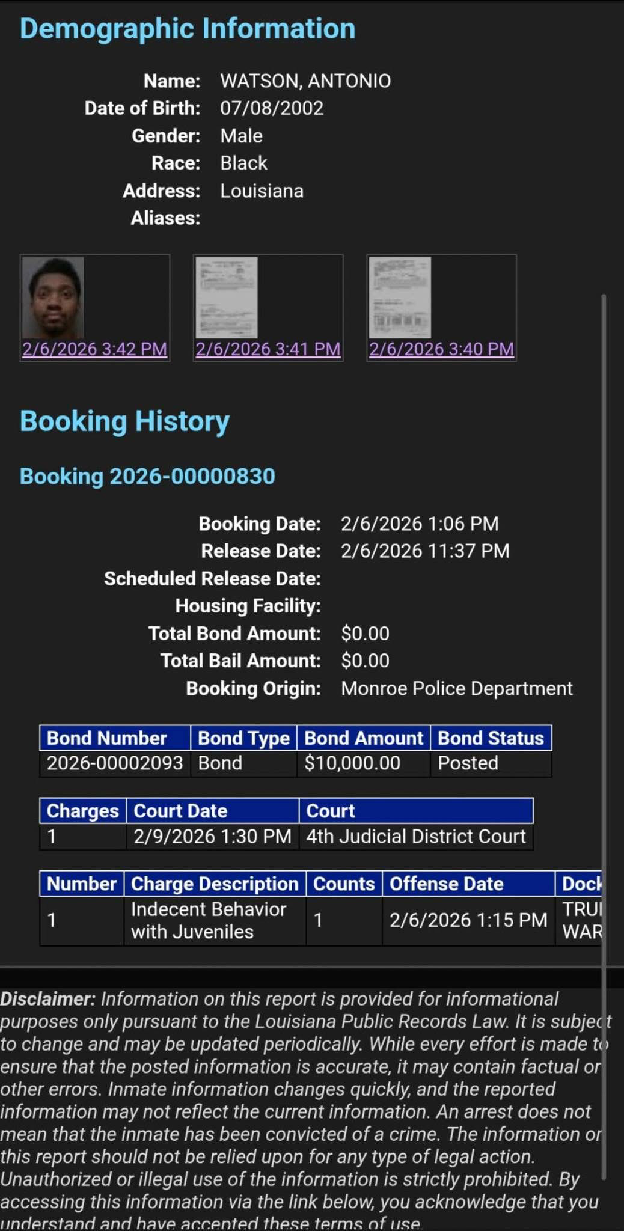
    A substitute teacher at Carver Elementary School was arrested and charged with indecent behavior with juveniles, according to public arrest records. The charge is an allegation, and the case is pending in court.

    The incident is alleged to have occurred on February 4, 2026. A family of one affected student says they were not notified immediately and only learned of the situation after their child disclosed it at home. To protect the child, no identifying information is being released, including gender or grade level.

    One family member briefly made a public post out of concern that other children may have been involved or exposed, noting that multiple students were present in the classroom at the time. The post was later removed after the family became worried that public discussion could further harm or identify the child. The child shared graphic details with their families about the occurrence — and how one child stated they felt trapped under the desk while the act was performed. The family says their intent was never public exposure, but to raise concern that some children may be afraid to speak up, especially if parents were never informed or asked to talk with their children.

    Shortly after that post, the school issued a brief public statement acknowledging that an allegation had been reported and referred to law enforcement, stating that the matter was under investigation and that no further comments could be made at that time. According to the family, that statement is the primary communication they have received.

    According to the family, they attempted to file a police report themselves but say they were unable to do so initially because they were not provided with key information, including the name of the substitute teacher involved. The family says they requested this information from the school and were denied access at the time, leaving them unable to complete a report without identifying details. They are now seeking clarity on why that information was not made available to them sooner and whether this aligns with district policy when parents are attempting to report alleged criminal conduct involving their child.

    One family reports the child is now experiencing severe anxiety and trauma-related symptoms and says no counseling or support services have been offered unless the family requested it. They are asking why parents of children who were present were not notified directly, whether additional students may have been affected, and what protocols exist to support children in situations involving alleged sexual misconduct.

    Because the school has publicly stated that no further comment is available, they are not currently providing additional statements. This remains an ongoing story. I am working closely with the family privately to advocate for them while prioritizing the child’s safety and well-being, and I will share updates as information can be responsibly confirmed.

    TLDR:
    A substitute teacher was arrested and charged with indecent behavior with juveniles. A family says they were not promptly notified, fears other children may have been affected, and worries some may be afraid to speak up because parents were not informed. The school issued a brief statement and says no further comment is available. This is an ongoing investigation.

    CAN Report Image
    CAN Report Image

  • Part 3 — After the Whistle

    Series: The Richland Parish Data Center: Truth, Rumor & The Record

    Meta’s multi-billion AI-focused data center in Richland Parish is one of the largest private investments Louisiana has ever seen and one of Meta’s largest data centers in the world. It promises jobs, infrastructure improvements, and economic momentum. But beyond the big numbers, many people are asking a practical question: what does this actually mean for the people who live here, both now and after construction ends?

    Today I’m breaking down the negative and the positive — it’s going to be a long one but stay with me.

    Jobs and Local Investment

    The construction phase is currently driving much of the economic activity. More than 3,700 workers are employed on site, with that number expected to peak near 5,000 within the year. Once the facility is operational, the workforce drops significantly to about 500 permanent jobs in specialized areas like IT, electrical work, engineering, security, and facilities management.

    In addition to direct employment, state estimates suggest more than 1,000 indirect jobs could be supported through logistics, retail, hospitality, and service industries. Meta and its contractors have already spent over $875 million with Louisiana businesses, benefiting more than 160 local companies. The project has also led to more than $300 million in infrastructure upgrades, including roads, water systems, and wastewater improvements that will remain long after construction is complete.

    The Ripple Effect on Small Businesses

    Even when large national firms win major contracts, they rarely do all the work alone. Local electricians, plumbers, HVAC companies, material suppliers, restaurants, hotels, and service providers often see increased demand as large contractors subcontract portions of the work and workers spend money locally. Many small businesses gain not only income, but experience and credibility that can help them secure future contracts.

    That ripple effect is strongest during construction. The goal is to turn short-term demand into long-term opportunity.

    Communities across the country that have hosted large data centers offer a useful comparison. In places like Northern Virginia, Ohio, and parts of Texas, data centers brought short-term construction booms, higher tax bases, and infrastructure upgrades, along with long-term, high-paying technical jobs. At the same time, many of those communities also experienced sharp drop-offs in employment once construction ended, housing pressure during peak build years, and ongoing concerns about energy use and utility costs. National studies consistently show that while data centers can anchor economic growth, the benefits last longest in communities that invest in workforce training, housing planning, and economic diversification rather than relying on the facility alone. Where those investments were missing, growth tended to plateau once the initial boom passed.

    Housing and Population Pressure

    Thousands of workers need places to live, and communities often respond by building new homes, expanding rentals, or converting short-term housing to accommodate them. That activity can be good for builders and property owners, but it also comes with risk.

    Construction workers are temporary by nature. Many will leave once the project is complete. If too much housing is built too quickly, the community could be left with empty homes and declining rental demand. If too little housing is built, prices can rise and push out long-term residents. Thoughtful planning is critical so housing growth matches the population that remains after construction ends.

    Utilities, Infrastructure, and Long-Term Costs

    Data centers require significant electricity and water. To support this project, power generation, transmission, roads, and utility systems are being expanded. These upgrades can benefit the broader community, but they also raise important questions about long-term maintenance and cost sharing. Communities elsewhere have learned that without careful planning, residents and small businesses can end up absorbing higher utility or infrastructure costs once construction slows. Later in the series we will take a closer look at the utility usages and risks.

    Taxes and Public Revenue

    Meta received tax incentives to locate in Richland Parish, which helped secure a major investment and infrastructure commitments. In the short term, that means less direct tax revenue from the company itself. However, contractors, workers, and supporting businesses generate income, sales, and property taxes that help fund schools, roads, and local services.

    Much of this revenue peaks during construction. Whether those benefits last depends on whether workers settle here permanently and whether local businesses are positioned to continue growing once the project is complete.

    A Parish Already Facing Population Decline

    This project arrives at a time when Richland Parish has been losing population for years. The parish had about 20,725 residents in 2010. By 2020, that number dropped to just over 20,000, and current estimates place it under 19,700. This investment presents a real chance to slow or reverse that trend, but only if people choose to stay.

    If families settle here, schools could see higher enrollment and increased funding. Local businesses could gain steady customers. If most workers leave, the parish risks returning to the same challenges it faced before construction began.

    How Residents Can Help Make the Benefits Last

    Large projects do not automatically create lasting prosperity. Communities that benefit long-term are the ones that engage early and stay involved.

    Residents can take advantage of this moment by supporting workforce training and certification programs that help locals qualify for permanent jobs. Small business owners can position themselves for subcontracting opportunities and future projects by building relationships now. Community members can advocate for housing, school funding, and infrastructure planning that reflects long-term population needs rather than short-term peaks. Encouraging economic diversification and quality-of-life investments helps ensure the parish is not dependent on a single employer.

    Most importantly, staying informed and involved gives residents a voice in how growth happens and who it benefits.

    The Bottom Line

    The Meta data center is not a guarantee of success or failure for Richland Parish. It is a chance. Whether this moment leads to sustainable growth or a short-lived boom depends on planning, participation, and long-term thinking.

    In the next article, we will take a closer look at the environmental effects of large data centers, including energy use, water demand, and how those impacts can affect rural communities like ours.

  • Part 2 — The Labor Yard

    Series: The Richland Parish Data Center: Rumor, Fact, and the Record

    As construction continues on the Meta data center in Richland Parish, the project has become a magnet for speculation. Some residents believe outsiders are taking all the jobs. Others insist locals were never meant to benefit at all. Meanwhile, some are already seeing opportunities roll in.

    To better understand what is real and what is rumor, I sat down with local business owners, residents, and on-site workers and reviewed publicly available data and documented programs. What I found was far more complex and far less conspiratorial than online discourse suggests.

    Local Businesses Feeling the Strain

    My first stop was Opal’s, a local food truck owned by Logan and Katie. After ordering a to-die-for chicken sandwich, we got down to business. They shared that while they were initially excited about the data center, they now feel left behind by the multi-billion-dollar project.

    When they first learned about the development, they believed their best option was to invest their life savings into a food truck and serve the community through the transition. Katie explained that business was strong when they first opened, but since Thanksgiving, constant road closures have reduced their daily customers from roughly 100 to around 30.

    You will find Opal’s parked about a mile from the main data center. When asked why they are not located in the food truck park, Katie answered immediately, saying it costs $2,500 per month. That price does not include water. For a new small business, it is simply not feasible. While other locations exist, they said they have been priced out of all of them.

    Their frustration deepened when they learned that food trucks are reportedly operating inside the construction site itself and catering directly to crews. Despite repeated attempts, they have been unable to even get a call back about similar opportunities. Katie shared that she was initially told locals would be among the first included, but now feels that outside businesses are being given exclusive access.

    Beyond business concerns, they are also worried about changes to their neighborhood. They live on a dead-end road where their children have always been able to play freely, surrounded by only a few neighbors. Now, plans are underway to install a mobile home and RV park with at least 700 lots to house workers. They worry about the sudden influx of new residents and how it will impact their sense of safety and community.

    Despite these challenges, Logan and Katie are committed to staying. Logan shared that he felt almost forced out of farming, his previous livelihood. There was no preparation period, only the sudden appearance of construction lights and the need to scramble for a backup plan. He expressed that he is willing to adapt but wishes there had been more transparency from local leadership so families like his could plan instead of react.

    Contractors Finding Opportunity

    As we finished our meal, several construction workers arrived to order lunch. Their trucks belonged to Holy Dippers, a local plumbing and septic company contracted for the project. Larry Ezell explained that the company owner was simply in the right place at the right time, meeting the right contractor who offered an opportunity.

    The company expanded quickly to meet project demands. Larry said they have offered jobs to locals, but many declined because they did not want to work the required hours. He emphasized that the work is there for those willing to commit. His crew expressed gratitude for the opportunity and optimism about future phases of the project, even knowing the current contract will not last forever.

    A Local Success Story

    Next, I visited Holy Tacos in Rayville, a taco truck that has since become a permanent location. Owner Tim Allen, who also serves as a local children’s minister, shared a very different experience. Tim has a recurring catering contract with Meta, often serving more than 1,500 tacos at a time.

    He repeatedly expressed gratitude for the project, explaining that it allowed his family to stay together and remain rooted in Richland Parish. His business is entirely run by himself, his wife, and their children. He believes the data center created opportunities that previously did not exist for his kids in the local job market.

    Tim encouraged residents to find ways to adapt rather than resist the changes. He acknowledged that fear of the unknown is natural, but believes there is space for locals to succeed if they are willing to find where they fit. While sympathetic to those living closest to the construction, he remains optimistic about the growth and future business development the project will bring.

    If nothing else, one clear benefit has emerged. The tacos are excellent.

    Understanding the Workforce Reality

    After hearing such mixed experiences, I wanted to better understand employment realities for locals who cannot afford to start a business to adapt. I spoke with a group of on-site workers who had traveled from out of state.

    They were grateful for the opportunity but admitted they missed home. Travel, they explained, is simply part of the job for skilled laborers. According to them, there were not enough local workers with the required training to support a project of this scale. One worker noted that hiring locals would be far more cost-effective for employers, as lodging and per diem expenses are substantial.

    They emphasized that their work requires specialized training and is not general labor. The group encouraged locals to consider trade school, stating that there is enough work for everyone willing to adjust to demanding schedules.

    Training Programs and Economic Data

    While I could not independently verify every claim shared with me, multiple locals referenced a trade school program offered through Louisiana Delta Community College, which includes stipends for Richland Parish residents and job opportunities upon completion. I also learned of several job fairs hosted in the parish, though specific hiring outcomes were not available.

    What can be verified is that large industrial projects often rely on a combination of local labor, regional contractors, and specialized out-of-state workers, particularly during peak construction.

    In January 2026, Louisiana Delta Community College launched a Data Center Technician Program designed to prepare local residents for long-term technical roles tied to data center operations. These positions offer starting wages between $18 and $24 per hour, with advancement opportunities as the facility transitions into full operation.

    Meta has also invested earlier in workforce development. The company donated $50,000 to Richland Parish Public Schools to support technology and STEAM education, including mixed-reality tools meant to introduce students to technical career paths before graduation.

    According to Louisiana Economic Development, Meta has contracted more than $875 million with Louisiana companies, with 84 percent of those businesses located in Northeast Louisiana. These contracts span construction, logistics, food services, and maintenance.

    Hiring is not centralized solely through Meta. Locals can apply through the Richland Parish Data Center hiring portal or directly with major contractors such as DPR Construction, Turner Construction, and Mortenson. State-administered workforce programs also exist to support training and credentialing for high-demand industries and are commonly used for large infrastructure projects statewide.

    Looking Ahead

    From what I have seen, opportunity does exist for those willing and able to pursue it. That reality does not diminish the struggles many locals are facing. Adjustment periods are real, and not everyone can pivot at the same pace. However, additional business growth is expected to follow, creating new opportunities beyond the data center itself.

    In a meeting with Mayor Ellis, he expressed strong support for the project, stating that when one parish wins, the region benefits. While Monroe has historically served as the labor hub for North Louisiana, Richland Parish is now contributing jobs that support surrounding communities as well.

    Next, I will take a closer look at additional job growth expected outside of the data center and the broader economic ripple effects this transition may bring.