Tag: Infrastructure

  • Shadow Glen Apartments — Health and Safety Concerns

    Location: West Monroe, LA

    Residents of Shadow Glen Apartments say ongoing infrastructure, safety, and sanitation issues are severely impacting their quality of life, with some alleging conditions that pose potential health and safety risks.

    Multiple residents report that water service at the complex is interrupted several times a week — sometimes daily — often without prior notice. According to residents, the shutoffs are attributed to an unresolved leak that has persisted for nearly two years. Despite the frequent interruptions, tenants say they continue to be charged a monthly water bill.

    Several residents also claim that raw sewage has leaked into common areas and individual apartments. One resident reports sewage backing up into her unit while she had a newborn, stating it took more than two weeks for the issue to be permanently repaired and cleaned. Residents allege that temporary fixes are often made, but cleanup efforts are inconsistent or nonexistent.

    Beyond plumbing concerns, residents describe what they say are widespread maintenance and sanitation issues across the property. Complaints include roach and rat infestations that contaminate their food and water supply, malfunctioning washers and dryers, improperly sealed doors that allow water intrusion during rainstorms, and electrical outlets that spark during use. One resident says smoke detectors were not replaced until weeks after safety inspections had already been conducted.

    Safety concerns were also raised regarding animals and unauthorized individuals on the property. Residents report dogs frequently roaming loose, including breeds listed as restricted under the complex’s policies. Some say they have had close encounters with dogs owned by residents who repeatedly allow their animals to roam freely, causing anxiety for those uncomfortable around stray or unleashed dogs.

    In addition, residents say common areas such as the dog park and trash disposal areas are often avoided at night due to fears stemming from homeless individuals reportedly sleeping in those locations.

    Other concerns cited by residents include:
    – Trash accumulation and abandoned grocery carts at building entrances
    – Persistent odors of marijuana throughout the complex
    – Frequent police presence and reported criminal activity
    – Loud and disruptive neighbors
    – Dog waste left throughout the property
    – Lawn care crews allegedly damaging residents’ outdoor belongings
    – A large, unattended hole — approximately three feet deep — left on the property for weeks before being repaired
    – Pool access issues due to lack of monitoring, with unauthorized use reported

    Residents say repeated complaints to management have not resulted in lasting solutions, leaving many feeling unheard and frustrated.

    For transparency, I previously and briefly worked at Shadow Glen Apartments under former management and left because of ongoing maintenance and safety concerns. I have no current ties to the property, but residents’ complaints reflect problems that predate my departure.
  • Resident Concerns at Westbrook Villa Apartments

    Location: West Monroe, LA

    Residents of Westbrook Villa Apartments say they are dealing with a growing list of unresolved maintenance issues, safety concerns, and rising costs that have made day-to-day living increasingly difficult.

    The concerns outlined in this article are based on information provided by residents. One resident agreed to speak on the record on the condition of anonymity, while additional accounts were shared off the record to provide context and corroboration. Names are being withheld to protect residents from potential retaliation.

    Westbrook Villa is believed to be owned or managed by the same individuals connected to Shadow Glen Apartments, a complex previously referenced in earlier reporting. While ownership details are still being reviewed, tenants say the conditions and management practices feel strikingly similar.

    Multiple residents who spoke on condition of anonymity described problems that began before move-in and have continued throughout their leases.

    Several tenants report that severe roach infestations were present before they moved in, but they were not informed until after leases were signed and keys were issued. Residents say pest issues have persisted with limited or ineffective treatment, ruining furniture and appliances, like microwaves, that they will have to dispose of once they move out.

    Plumbing problems are another recurring complaint. Tenants report bathtubs that do not drain properly, requiring plungers to empty water, with no permanent repairs made. Constant leaks with sinks and in shared spaces have also been reported.

    Inside individual units, residents say repairs are often incomplete, including doors being replaced but never painted and fixtures left unfinished. While tenants say maintenance may respond initially, they claim issues frequently reoccur.

    Safety and quality-of-life concerns were also raised. Residents report unaccompanied minors playing unsupervised, sometimes causing property damage, as well as reports of crime within the complex. Tenants say late-night noise and loud music often go unenforced, despite complaints.

    Water-related issues appear to be among the most disruptive. Residents report that water service has been shut off for full days without warning on multiple occasions, forcing families to use gas stations or other public facilities for restrooms. The on-site laundry room is also reported to flood regularly, making it unusable at times.

    Adding to the frustration, tenants say water lines have burst repeatedly, and because residents are responsible for water bills on site, some say they have been charged for excessive water usage caused by infrastructure failures, not personal use.

    Financial concerns extend beyond utilities. Residents describe frequent rent increases and confusing add-on charges that they believe function as “hidden fees.” Several tenants said these charges appear quietly on statements without clear explanation or advance notice.

    Perhaps most concerning to residents is the feeling that they are held financially responsible for problems they are not allowed to fix themselves. Tenants say they are unable to make repairs or improvements, yet feel they are charged for how issues are handled — or left unresolved — while being expected to continue living with the conditions.

    Residents say they are speaking out not only to seek accountability, but to inform others considering housing options in the area.

  • Ouachita Parish Fire Department — Chief Robert Moore Interview

    In a sit-down interview, Robert Moore, Fire Chief of the Ouachita Parish Fire Department, said the department’s mission is simple: to serve the public and meet community needs.

    “We’re here to help,” Moore said. “I just don’t think people realize everything we do.”

    Many residents only interact with the fire department during emergencies, but Chief Moore says the department provides far more services than most people realize. He has served with the department for nearly 15 years and brings more than 35 years of public safety experience to the role.

    Ouachita Parish operates as one unified fire district, covering nearly the entire parish outside of Monroe and West Monroe. Unlike many areas in Louisiana that rely on small volunteer districts, Ouachita Parish runs as a coordinated system with 15 fire stations, with a 16th station planned along Highway 80 near Trapp Field, currently projected for 2028.

    While fire suppression is a core responsibility, about 80% of calls are medical. Many firefighters are paramedic-certified and provide advanced life support, often arriving before ambulance services. The department is also the only local agency with mechanical CPR devices on every frontline truck, allowing consistent chest compressions during cardiac arrest and transport — a critical factor in survival, especially in rural areas.

    Despite covering more than 600 square miles, the department holds a Class 3 fire rating, considered exceptional for a district of this size and one that can positively affect insurance rates. Moore says the department plans years in advance for major purchases like fire engines, ladder trucks, and stations, allowing them to operate without debt or bonds and stay within budget.

    The department also offers several free services many residents don’t know about, including free smoke alarm installation, fire safety education in schools, CPR and first responder medical training, fire protection reviews for new subdivisions, and assistance with gas or carbon monoxide concerns. If a request falls outside their jurisdiction, staff help connect residents with the appropriate agency.

    Ouachita Parish Fire Department maintains an Urban Search and Rescue team and is part of a regional response network activated through the Louisiana State Fire Marshal. Local firefighters have deployed to floods, hurricanes, and other disasters both in Louisiana and out of state. The department is also trained and equipped for high-angle rescue, confined space rescue, and water rescue, with all equipment and training maintained in-house.

    While life-threatening emergencies take priority, firefighters also respond to animal rescue calls when needed, including animals trapped in vehicles, trailers, or dangerous situations. In many cases, animal control or law enforcement requests assistance due to the specialized equipment required.

    The department employs approximately 190 personnel, including firefighters, dispatchers, training staff, and maintenance crews. On any given day, at least 46 firefighters are on duty, working 24-hour shifts. The department operates its own in-house fire academy, which lasts about a year and includes EMT certification and fire suppression training. The department is currently hiring and expects to bring on around 15 new firefighters this year.

    Those interested can learn more at:
    – ouachitafire.org
    – 318-325-1621
    – Facebook

  • Taking the Lock Off City Hall — Don Nance Interview

    (TLDR at end)

    Today I sat down to interview Mr. Nance at his local business in West Monroe. His message was clear: not just access to information, but access to leadership.

    Nance, who previously worked for the City of West Monroe for 13 years under prior leadership, says his decision to run is rooted in what he believes has been lost in recent years. He points to transparency, financial discipline, and an open relationship with the people as central concerns.

    And he framed it in a way that was hard to ignore.

    “When the current mayor ran, she talked about transparency and an open-door policy,” Nance said. “The first thing she did was put a lock on the elevator at City Hall so you can’t access the second floor.”

    His promise?

    “I will literally and figuratively take the lock off.”

    A Focus on Financial Reality

    Nance does not shy away from discussing the city’s finances. He repeatedly pointed to what he describes as a growing debt burden, citing approximately $42 million in debt, along with long-term bond payments tied to projects like the West Monroe Sports Complex.

    According to Nance, the issue is not whether amenities are nice to have. It is whether they are sustainable.

    He expressed concern about multiple city-owned event venues operating at a loss. His solution is not to abandon them, but to manage them differently.

    “If it’s going to survive without draining tax dollars,” he explained, “it has to be booked constantly. You can’t rely only on local youth leagues. You have to bring in outside events.”

    Rather than pointing fingers, Nance says his approach would be practical. He wants to run the city the way he runs his own businesses, with financial restraint, long-term planning, and clear priorities.

    “There’s a time to eat beans, and there’s a time to eat steak,” he said. “Right now, we need to be asking, does this make us safer? Does this fix our water? Does this improve our streets? If not, it moves down the list.”

    Clean Water: A Long-Term Commitment

    Water infrastructure is another major pillar of Nance’s campaign.

    He was careful not to promise overnight fixes. West Monroe’s water system pulls from multiple sources, which makes filtration upgrades complex and expensive.

    “It’s not a day-one solution,” he said. “If it was easy, it would already be fixed.”

    However, he believes the city should aggressively pursue available federal infrastructure funding that is specifically earmarked for water improvements.

    His stance is simple. If grant money exists for clean water, it should be pursued just as aggressively as funds for other projects.

    Public Safety and Protecting Children

    Nance also emphasized safety, particularly when it comes to theft and school security.

    He described personal experiences with property theft and advocates for increased night patrols in neighborhoods. One of his strongest positions was clear.

    He wants a police officer in every school within city limits.

    “We can make cuts in other areas,” he said. “But what’s more important than our children?”

    Beyond policing, Nance talked about building unity across pastors, coaches, teachers, parents, law enforcement, and community members to mentor young people before problems begin.

    “This isn’t about national political debates,” he said. “It’s about running a city. It’s about unity.”

    Supporting First Responders

    Another issue he raised was employee benefits for police officers and firefighters.

    Nance believes it is unacceptable for first responders to risk their lives while struggling to afford family health insurance.

    “If someone is willing to protect this city, we should protect them,” he said.

    He indicated he would prioritize reviewing and strengthening those benefits if elected.

    Involving the Citizens in Decision-Making

    Perhaps the most consistent message of the conversation was inclusion.

    Nance repeatedly emphasized that major city decisions should not happen in isolation.

    “When the council meets and we’re deciding what to spend money on, I want citizens involved,” he said. “They know their neighborhoods. They know their problems.”

    He described canvassing neighborhoods personally and hearing directly from residents who felt unheard.

    He says transparency is not just about publishing numbers. It is about accessibility. It is about answering the phone. It is about meeting face to face. It is about removing barriers, both physical and symbolic.

    A Commitment to Accountability

    At the close of our conversation, I asked Nance directly whether he would commit to transparency and accountability with me as an independent journalist, even if criticism arises.

    His response was immediate.

    “100 percent yes.”

    Whether voters agree with every position or not, Nance’s campaign message is clear. Restore financial discipline. Prioritize core services. Strengthen public safety. And perhaps most notably, give the citizens a key to City Hall.

    In his words, it is time to take the lock off.

    TLDR: Taking the Lock Off City Hall

    Don Nance says he’s running for mayor of West Monroe to restore transparency, financial discipline, and public access to leadership. He believes the city is carrying significant debt and wants to prioritize core services like clean water, safer streets, and stronger support for police, fire, and schools before funding additional projects.

    He supports pursuing federal funding to address long-term water infrastructure issues, increasing neighborhood patrols, placing officers in every school, and reviewing benefits for first responders.

    Most importantly, he says he wants citizens directly involved in decision-making and promises to be accessible and accountable. In his words, he plans to “literally and figuratively take the lock off” City Hall.

  • Industrial Groundwork in Ouachita Parish?

    OPPJ — Public Records Review

    Over the past few weeks, I’ve been digging through Ouachita Parish public records. Looking at budgets, meeting minutes, audit reports, and capital outlay documents. I’m trying to better understand how parish tax dollars are being spent and what long-term plans may be underway.

    One pattern that stands out in the records is the parish’s repeated use of two categories: East Ouachita Economic Development Capital Outlay and West Ouachita Economic Development Capital Outlay. These funds appear throughout the financial documents and meeting minutes and are specifically tied to economic development spending.

    In plain terms, “capital outlay” usually refers to money used for large projects such as infrastructure, engineering work, planning, and development preparation. It is different from routine expenses like payroll or daily operations. Capital outlay funds are typically used when a government is investing in long-term projects.

    The documents show the parish approving funding connected to planning, engineering work, and infrastructure improvements under these economic development categories. While the records do not name a specific company or project, these types of expenditures are often associated with early-stage development planning.

    Another detail that appears consistently in the records is the geographic separation of spending between East Ouachita and West Ouachita. That type of distinction can sometimes indicate that development planning is being focused in particular areas of the parish rather than applied evenly everywhere.

    In many communities, the early phases of industrial or large-scale economic development follow a fairly predictable pattern:

    1. Engineering or feasibility studies are approved
    2. Infrastructure planning begins (roads, utilities, site preparation)
    3. Capital outlay funds are allocated
    4. Sites are prepared or certified for development
    5. A company announcement may happen later

    The documents reviewed so far appear to show activity that fits within the early stages of that process. However, the records themselves do not identify a specific industry, company, or project.

    Another interesting piece of the puzzle is that some of the investments appear tied to infrastructure and development planning that could support large projects requiring significant utilities, broadband access, or transportation access. Those types of investments are often made years before any official announcement is made.

    To be clear, this does not mean a specific industrial project or company has been confirmed. What the documents show is that the parish has been allocating funds and approving planning activity tied to economic development infrastructure.

    At this stage of the investigation, the goal is simply to understand what these funds are being used for and what long-term development plans may exist.

    I am still requesting types of documents that often provide more detail about whether a parish is preparing land for future industry or large employers.

    As always, I want to be clear that I am not an attorney and not claiming wrongdoing. My goal is simply to review public records and help make complex government documents easier for the community to understand.

    Public information helps everyone better understand how our local government is planning for the future. We deserve to be informed. As I look through the OPPJ meeting minutes, I haven’t found any public information on plans for industrial development but in my opinion, the financial records seem to indicate that is the direction they are heading. I wonder at what point a public announcement would be made?

  • Where Did the COVID Relief Money Go?

    OPPJ — ARPA Spending Review

    I’m not an attorney or an accountant. I’m simply a citizen reviewing public records and trying to understand how public funds are being used.

    One of the biggest questions that came up during this review is this: How was the federal COVID relief money actually spent in our parish?

    What ARPA Funds Are

    During the COVID-19 pandemic, the federal government passed the American Rescue Plan Act (ARPA). This program sent millions of dollars to local governments, including Ouachita Parish. These funds were intended to help communities recover from the pandemic through things like:
    – Public health responses
    – Economic recovery
    – Infrastructure improvements
    – Assistance to nonprofits and community organizations
    – Replacing lost government revenue

    Because this was federal taxpayer money, it’s important that the public understands where it went and what it was used for.

    What the Records Show

    After reviewing the ARPA reports and spending records, the funds appear to have been distributed across several different areas. Examples include funding for:
    – Infrastructure and capital projects
    – Workforce development initiatives
    – Nonprofit and community programs
    – Economic development efforts
    – Administrative and professional services

    Some funding was directed toward organizations and community programs, while other funds went toward planning, infrastructure improvements, and regional development projects. Many of these uses fall within categories that were permitted under federal ARPA guidelines.

    However, one thing becomes clear when reviewing the records: the spending is spread across many different departments and reports.

    Why That Matters

    Because ARPA money was distributed across multiple programs and funds, it becomes difficult for the public to quickly answer a simple question: How much money went to each project, and what outcomes did it produce?

    Instead of one simple list, the information appears across:
    – Multiple departments
    – Multiple projects
    – Multiple financial reports
    – Multiple funds

    That means it takes significant time digging through records to piece together the full picture.

    Questions Worth Asking

    Based on the documents reviewed so far, there are a few questions that naturally follow:
    – How were projects selected for ARPA funding?
    – How much of the allocated money has actually been spent?
    – What measurable results are tied to these projects?
    – Were these spending decisions clearly discussed in public meetings?

    These aren’t accusations. They’re simply the kinds of questions communities ask when millions of taxpayer dollars are involved.

    Why Transparency Matters

    Federal COVID relief funds were meant to help communities recover from a historic crisis. Because of that, the public deserves to understand:
    – Where the money went
    – How the decisions were made
    – What benefits the community received

    Public records exist for exactly this reason. As I continue reviewing documents, I’ll continue sharing what I find so the community can better understand how these funds were used.

  • Consumer Groups Sound Alarm After Louisiana PSC Declines to Investigate

    Series: The Richland Parish Data Center

    Consumer advocacy organizations are raising serious concerns after the Louisiana Public Service Commission (PSC) declined to investigate a complex financing arrangement tied to Meta’s $27 billion data center project in Richland Parish.

    According to a press release issued this week, Earthjustice, the Alliance for Affordable Energy, and the Union of Concerned Scientists had requested that the PSC examine what they describe as a “risky” financial restructuring involving Meta and Blue Owl Capital.

    Here’s the concern:

    Originally, the PSC approved Entergy Louisiana’s plan to build three new gas plants and related transmission infrastructure to power Meta’s data center. That approval was based on financial assurances that were intended to protect ratepayers from long-term risk.

    However, on the same day that approval was granted in August 2025, Meta reportedly restructured the deal. Through a joint venture with Blue Owl Capital, Meta reduced its ownership stake in the data center’s holding company to 20%. The new entity borrowed $27 billion to finance the project.

    Consumer groups argue this restructuring allows Meta to walk away from the project after just four years under its lease agreement, while the gas plants being built to power the facility are designed to operate for 30 years.

    If the data center closes early, advocates warn that Louisiana ratepayers could be left responsible for the remaining costs of the fossil-fuel infrastructure. In addition, more than half a billion dollars in transmission costs tied to the project will reportedly be spread across Entergy customers once construction is complete.

    The motion filed in January asked the PSC to conduct a prudence review and investigate whether Entergy was aware of the financial restructuring prior to the August vote. The Commission declined to take up the request.

    Consumer groups say the decision denies the public an opportunity to fully examine how this financing structure could impact household utility bills. They argue regulators have a responsibility to reassess projects when major financial terms change.

    Supporters of the project, meanwhile, have pointed to economic growth, construction jobs, and tax revenue associated with the data center buildout.

    The broader question now facing Louisiana residents is this:
    Who ultimately bears the long-term financial risk if the structure of the deal changes?

    As this project moves forward, transparency and accountability remain at the center of the debate.

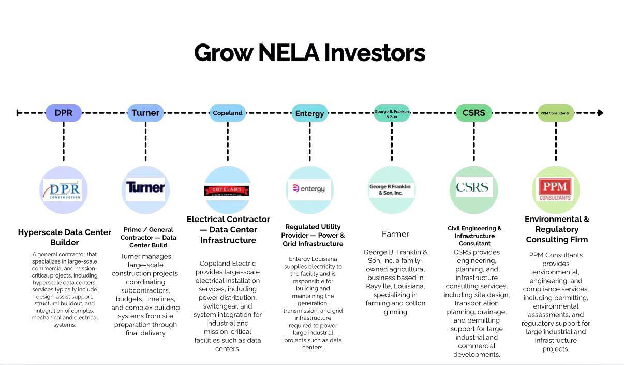
  • Bonus Feature: The Digital Footprint (Chart 2)

    Bonus Feature: The Digital Footprint (Chart 2)

    Series: The Richland Parish Data Center: Truth, Rumor & The Record

    This graphic is the first in a bonus series breaking down the structure behind the Richland Parish Data Center project.

    To be clear: this is not an accusation of wrongdoing. It is an informational overview of investors who have the closest structural proximity to the construction and infrastructure layers of the project.

    This chart focuses on companies whose industry roles align directly with large-scale industrial builds — including prime contractors, heavy civil construction, electrical infrastructure, engineering, and utility providers. These categories are typically involved in site preparation, power delivery, construction management, permitting, and systems integration.

    The purpose is to explain how large projects like this are built and which sectors are positioned within that execution ecosystem. Investor status does not automatically mean a company was awarded a contract or had decision-making authority. It simply shows financial participation in the regional economic development organization alongside industry alignment.

    As I continue reviewing public documents and awaiting responses to records requests, future charts will explore additional layers — including timeline, governance structure, and broader economic impact.

    The goal is transparency and understanding of process, not speculation.

    More information to come.

    CAN Report Image

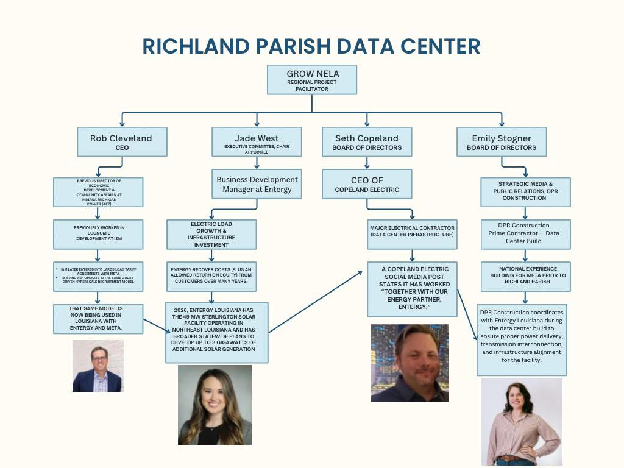
  • Bonus Feature: The Digital Footprint (Chart 1)

    Bonus Feature: The Digital Footprint (Chart 1)

    Series: The Richland Parish Data Center: Truth, Rumor and The Record

    Remember these names, remember these faces — this is one of many charts I’ll be dropping just to fill you in on the connections that deserve clarity.

    It simply maps out publicly documented roles connected to the Richland Parish Data Center: regional economic development (Grow NELA), the utility provider (Entergy), and contractors involved in the build (DPR and Copeland Electric). These kinds of projects typically move through recruitment, infrastructure planning, and regulatory approval before public announcement, often within a relatively small professional network.

    The purpose of this graphic is to show structure — not to suggest wrongdoing. Many citizens have said they felt left out of the loop, so I’m laying the groundwork to better understand how the process unfolded. I’m still waiting on public records requests, and future posts will include more documentation as it becomes available.

    CAN Report Image

  • Part 6 — The Local Layer (1 of 2): What We Know Now

    Series: The Richland Parish Data Center: Truth, Rumor & The Record

    As I continue examining the local layer behind the arrival of Meta to northeast Louisiana, I want to begin by clearly separating what is documented and confirmed from what remains under review.

    Major projects like this do not move forward through corporations alone. They move through regional boards, nonprofits, utilities, chambers of commerce, and public officials who operate much closer to home. Understanding that local layer is essential.

    Confirmed Board Overlap

    Public nonprofit filings show that both Friday Ellis and Shane Smiley served on the board of Grow NELA during the period when the Meta data center was being promoted. Grow NELA later transitioned into Grow Northeast Louisiana, with overlapping leadership involved in that restructuring.

    It is also documented that during this period, the nonprofit reported significant legal and consulting expenditures and later transferred assets as part of its transition.

    Those facts are not allegations. They are contained in publicly filed nonprofit documents.

    Entergy Representation

    Board listings also show representation connected to Entergy, the regional electric utility. That is not unusual for economic development organizations. Utilities frequently sit on regional boards because infrastructure and power commitments are central to industrial recruitment.

    However, it is a relevant structural detail given that hyperscale data centers like Meta’s are heavily dependent on long-term power agreements and grid capacity planning.

    Richland Parish Chamber Overlap

    There is also documented overlap between Grow NELA board membership and the Richland Parish Chamber of Commerce. Chamber leadership participation in regional development boards is common, but it is part of the broader ecosystem that shaped regional economic strategy during the same timeframe.

    These overlapping roles do not imply wrongdoing. They do, however, illustrate how interconnected regional leadership can be during major project development.

    Direct Questions to Local Officials

    Because of public speculation surrounding non-disclosure agreements and local involvement, I reached out directly to Mayor Ellis and to Shane Smiley for comment and clarification on the rumors circling.

    Mayor Ellis responded.

    In his response, he stated that he did not personally sign any non-disclosure agreement related to Meta, site selection, or economic development discussions. He also stated that the City of Monroe did not sign any non-disclosure agreements related to the project.

    Ellis acknowledged that confidentiality agreements are common during early site evaluation processes but stated that any such agreements would have been handled at the organizational level and that he was not a signatory.

    He further stated that he did not participate in Meta site selection negotiations and was not involved in Meta-related discussions at either the city level or within the nonprofit. He described his board role as general governance and regional economic development strategy rather than project-level negotiation.

    As of publication, Shane Smiley has not responded to a request for comment regarding the same questions.

    I also reached out to the Mayor of Rayville for comment. That call has not been returned.

    What Happens Next

    Public records requests have been submitted seeking:
    – Board meeting minutes
    – Confidentiality agreements
    – Legal expenditure documentation

    Those records are pending.

    Part Two of The Local Layer will move beyond board structure and governance and examine another critical piece of the story: how the land for the Meta project was acquired and what can be expected moving forward in terms of land purchasing, development expansion, and regional real estate impact.

    When projects of this scale arrive, the story is not just about a corporation. It is about the network of local leadership, institutions, infrastructure partners, and property decisions that shape what happens next.

    This first installment focuses on what is documented and confirmed.

    The next will examine the land, the transactions, what they may signal about the future and what the pending records can confirm.