Tag: Public Records

  • Where Did the COVID Relief Money Go?

    OPPJ — ARPA Spending Review

    I’m not an attorney or an accountant. I’m simply a citizen reviewing public records and trying to understand how public funds are being used.

    One of the biggest questions that came up during this review is this: How was the federal COVID relief money actually spent in our parish?

    What ARPA Funds Are

    During the COVID-19 pandemic, the federal government passed the American Rescue Plan Act (ARPA). This program sent millions of dollars to local governments, including Ouachita Parish. These funds were intended to help communities recover from the pandemic through things like:
    – Public health responses
    – Economic recovery
    – Infrastructure improvements
    – Assistance to nonprofits and community organizations
    – Replacing lost government revenue

    Because this was federal taxpayer money, it’s important that the public understands where it went and what it was used for.

    What the Records Show

    After reviewing the ARPA reports and spending records, the funds appear to have been distributed across several different areas. Examples include funding for:
    – Infrastructure and capital projects
    – Workforce development initiatives
    – Nonprofit and community programs
    – Economic development efforts
    – Administrative and professional services

    Some funding was directed toward organizations and community programs, while other funds went toward planning, infrastructure improvements, and regional development projects. Many of these uses fall within categories that were permitted under federal ARPA guidelines.

    However, one thing becomes clear when reviewing the records: the spending is spread across many different departments and reports.

    Why That Matters

    Because ARPA money was distributed across multiple programs and funds, it becomes difficult for the public to quickly answer a simple question: How much money went to each project, and what outcomes did it produce?

    Instead of one simple list, the information appears across:
    – Multiple departments
    – Multiple projects
    – Multiple financial reports
    – Multiple funds

    That means it takes significant time digging through records to piece together the full picture.

    Questions Worth Asking

    Based on the documents reviewed so far, there are a few questions that naturally follow:
    – How were projects selected for ARPA funding?
    – How much of the allocated money has actually been spent?
    – What measurable results are tied to these projects?
    – Were these spending decisions clearly discussed in public meetings?

    These aren’t accusations. They’re simply the kinds of questions communities ask when millions of taxpayer dollars are involved.

    Why Transparency Matters

    Federal COVID relief funds were meant to help communities recover from a historic crisis. Because of that, the public deserves to understand:
    – Where the money went
    – How the decisions were made
    – What benefits the community received

    Public records exist for exactly this reason. As I continue reviewing documents, I’ll continue sharing what I find so the community can better understand how these funds were used.
  • OPPJ Financial Review — Part 3

    Disclaimer: I am not an attorney or a CPA. This post is based on publicly available documents and audit reports. If something is incorrect, I welcome clarification.

    These are coming out as I get responses on my public record requests. I have my own suspicions and will tie it together at the end in an opinion piece. But for now, I’m laying the groundwork of what is documented.

    Over the past few weeks, I’ve been reviewing:
    – The 2024 Independent Audit
    – Financial records obtained through public records requests
    – ARPA (COVID relief) spending
    – Capital project fund summaries

    Here’s what stands out so far.

    1. The 2024 Audit Was Filed Late

    The audit itself says it was not submitted within the required deadline. In my opinion, late audits can point to administrative or internal control problems.

    2. Part of the Financial Picture Was Missing

    The auditors gave a clean opinion on the main government finances. However, they issued an adverse opinion on certain “component units” because those entities were not included in the financial statements.

    In simple terms: some legally separate entities connected to OPPJ were not included in the report. That affects transparency — not necessarily legality — but it limits the full picture.

    3. ARPA Reporting Was Off by $382,277

    The audit states that ARPA (federal COVID funds) reporting to the U.S. Treasury understated expenditures by $382,277. That does NOT automatically mean money was stolen. It means the reporting to the federal government was inaccurate and needed correction. That’s something that should be reconciled carefully.

    4. A $697,776 Accounting Correction Was Made

    The audit shows a prior-year correction involving $697,776 that had been classified incorrectly. This confirms that financial misclassifications have happened.

    5. There Is Ongoing Litigation Exposure

    The audit notes at least one lawsuit where potential liability could range from $1 million to $3 million if the outcome is unfavorable. That matters when evaluating legal spending and risk management.

  • What’s Going On Between the Judges and OPPJ — Part 2

    Deep Dive into OPPJ

    Disclaimer: I’m not an attorney. This is just my understanding based on public documents.

    • All of the sitting judges in the 4th Judicial District Court are listed as plaintiffs in a separate lawsuit against the Ouachita Parish Police Jury (OPPJ).
    • Because of that lawsuit, they stepped aside (recused themselves) from the Frost Tower case to avoid any appearance of conflict.
    • Court revenue from fines and fees has gone down in recent years.
    • The judges asked OPPJ for more funding to help cover expenses.
    • OPPJ increased funding for the judges from about $118,000 in 2022 to $525,000 in 2023.
    • Budget documents also show the Parish’s General Fund is under increasing financial pressure.

    To better understand the financial side, I’ve submitted a public records request asking for:
    – Payments made to outside lawyers (2023 to now)
    – Contracts and invoices for those legal services
    – Budget line items for legal expenses

    This isn’t about picking sides. It’s about understanding what’s happening and how taxpayer dollars are being used.

    I’ll continue sharing updates as documents come in — and I’ll stick to what can be proven.

  • Frost Tower LLC vs. OPPJ — Part 1

    Ouachita Parish Police Jury Deep Dive

    Disclaimer: I am not an attorney. This is simply my understanding of the court filings based on the public record.

    A company called Frost Tower, LLC has filed a lawsuit against the Ouachita Parish Police Jury (OPPJ) challenging the Parish’s subdivision regulations, specifically Chapter 21.5 of the parish ordinances.

    According to the petition, Frost Tower owns about 68 acres and wants to subdivide it into residential lots. The company is asking the court to declare that the Police Jury does not have the authority to enforce these subdivision rules as applied to them, and to stop the Parish from enforcing those rules on this development.

    The Police Jury responded in December by filing what are called “exceptions” and defenses. In simple terms, they are arguing that:
    – If someone is challenging the constitutionality of an ordinance, certain procedural steps must be followed
    – The Louisiana Attorney General must be properly served
    – The case may have been filed using the wrong type of court procedure

    They also deny the allegations and ask that the case be dismissed.

    One unusual development: all of the sitting judges of the Fourth Judicial District Court have recused themselves from the case. According to the recusal order, the judges are currently involved in separate litigation that includes the Police Jury, and they stepped aside to avoid any appearance of bias. That means a different judge will have to be assigned to handle this case.

    At this point, the case appears to be focused heavily on procedural issues before the court even reaches the larger constitutional question.

    Again, I am not offering legal advice. I am simply summarizing what is reflected in the filings. I will continue to follow the case as it develops.

  • The Crooked Smile of Leadership

    Ouachita Parish Leadership Under Scrutiny

    First things first:
    This is Part One of a series examining leadership and public trust in Ouachita Parish. Its purpose is not retaliation, but transparency. I am calling on local government leaders to review these concerns, evaluate Shane Smiley’s continued fitness to serve, and take appropriate action — including removal from the Ouachita Parish Police Jury if warranted.

    If meaningful action is taken to restore public trust, this series does not need to continue. If it is not, future posts will focus on documented patterns, community impact, verified claims I have uncovered, and mechanisms for accountability. The goal is simple: leadership that reflects the standards, presence, and integrity Ouachita Parish residents expect — especially in moments when the community needs it most.

    When video footage surfaced last year showing Ouachita Parish Police Jury President Shane Smiley speaking harshly and using profanity toward young female employees at his Monroe restaurant, Catahoula’s, it sparked widespread concern. Smiley apologized publicly but refused to resign, maintaining that the incident did not warrant removal from office.

    Since then, discussions and unverified rumors have circulated about workplace culture and his personal life, adding to growing public discomfort with his leadership. Multiple residents have expressed disappointment in his absence during the recent winter storm, citing a lack of visible leadership and communication during a critical time.

    During my recent investigations into Shane Smiley, I have uncovered information suggesting that his actions were not isolated and may continue to occur behind closed doors. While he remains active in official parish business, many residents feel accountability has not been fully addressed.

    Although this article primarily focuses on events from the past year, the concerns are ongoing. Sources have raised strong claims that, in my opinion, make Smiley unfit for his role as a publicly elected official.

    Citizens have noticed their inability to publicly comment on the government page representing the Police Jury and have turned to me for help. For now, I am posting limited (and already publicly circulating) information as a reminder that the public has not forgotten. In fact, they are more frustrated than ever. Echoes of citizens who feel their voices are censored and ignored sound locally, a troubling public perception considering the past issues.

    I am calling on local government leaders to review these concerns, evaluate Shane Smiley’s continued fitness to serve, and take appropriate and immediate action to remove him from his position as Police Juror.

  • The Overlap: Public Dollars, Private Influence

    The Overlap: Public Dollars, Private Influence

    This article may appear in multiple series, as the topics are intertwined.

    Economic development in Northeast Louisiana is often described as a public-private partnership. That model is common. What matters is how it functions in practice.

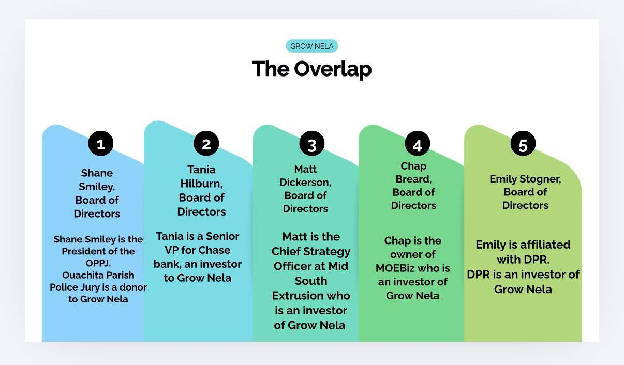
    A review of GROW NELA’s publicly listed Board of Directors and investor roster reveals a pattern of overlap between those who financially support the organization and those who help govern it.

    Documented examples include but are not limited to:
    Shane Smiley, President of the Ouachita Parish Police Jury. The Police Jury is listed as an investor in GROW NELA. Smiley also serves on GROW NELA’s Board of Directors representing the parish.
    Tania Hilburn, Senior Vice President with Chase Bank. Chase is listed as an investor in GROW NELA. She serves on the board representing the bank.
    Matt Dickerson, Chief Strategy Officer at Mid South Extrusion. Mid South Extrusion is listed as an investor in GROW NELA. He serves on the board.
    Chap Breard, owner of MOEbiz. MOEbiz is listed as an investor in GROW NELA. He serves on the board.
    Emily Stogner, affiliated with DPR Construction. DPR is listed as an investor in GROW NELA. DPR is also a prime contractor on the Meta data center project in Richland Parish.

    These connections are drawn directly from publicly available board and investor listings.

    This structure means that multiple entities financially supporting GROW NELA also hold governance positions within the organization.

    That structure is not automatically improper.

    However, when public institutions invest taxpayer dollars into an organization whose board includes private firms that may later benefit from development projects, the public has a right to review:
    – How funding agreements are structured
    – Whether conflicts of interest are disclosed
    – Whether recusals are documented
    – Whether procurement processes involving investor-linked firms are transparent

    Public Records Requests

    In order to better understand how these relationships operate in practice, I submitted public records requests to both the City of Monroe and the Ouachita Parish Police Jury seeking documentation of:
    – Contracts and cooperative agreements with GROW NELA
    – Payments to investor-linked firms
    – Procurement documentation related to those contracts

    After receiving no communication from the Police Jury, I visited their office in person. I was informed that my request was received on February 20. I requested written confirmation of receipt and was told the request had been forwarded to the Police Jury’s attorney.

    As of this writing, no records have been produced.

    Under Louisiana Public Records Law, public bodies are required to respond within three business days by either producing records or providing a written explanation and timeline.

    The State of Louisiana has acknowledged receipt of a related records request and indicated that documents are being compiled on their behalf.

    This review is ongoing.

    CAN Report Image

  • Consumer Groups Sound Alarm After Louisiana PSC Declines to Investigate

    Series: The Richland Parish Data Center

    Consumer advocacy organizations are raising serious concerns after the Louisiana Public Service Commission (PSC) declined to investigate a complex financing arrangement tied to Meta’s $27 billion data center project in Richland Parish.

    According to a press release issued this week, Earthjustice, the Alliance for Affordable Energy, and the Union of Concerned Scientists had requested that the PSC examine what they describe as a “risky” financial restructuring involving Meta and Blue Owl Capital.

    Here’s the concern:

    Originally, the PSC approved Entergy Louisiana’s plan to build three new gas plants and related transmission infrastructure to power Meta’s data center. That approval was based on financial assurances that were intended to protect ratepayers from long-term risk.

    However, on the same day that approval was granted in August 2025, Meta reportedly restructured the deal. Through a joint venture with Blue Owl Capital, Meta reduced its ownership stake in the data center’s holding company to 20%. The new entity borrowed $27 billion to finance the project.

    Consumer groups argue this restructuring allows Meta to walk away from the project after just four years under its lease agreement, while the gas plants being built to power the facility are designed to operate for 30 years.

    If the data center closes early, advocates warn that Louisiana ratepayers could be left responsible for the remaining costs of the fossil-fuel infrastructure. In addition, more than half a billion dollars in transmission costs tied to the project will reportedly be spread across Entergy customers once construction is complete.

    The motion filed in January asked the PSC to conduct a prudence review and investigate whether Entergy was aware of the financial restructuring prior to the August vote. The Commission declined to take up the request.

    Consumer groups say the decision denies the public an opportunity to fully examine how this financing structure could impact household utility bills. They argue regulators have a responsibility to reassess projects when major financial terms change.

    Supporters of the project, meanwhile, have pointed to economic growth, construction jobs, and tax revenue associated with the data center buildout.

    The broader question now facing Louisiana residents is this:
    Who ultimately bears the long-term financial risk if the structure of the deal changes?

    As this project moves forward, transparency and accountability remain at the center of the debate.

  • Bonus Feature: The Digital Footprint (Chart 2)

    Bonus Feature: The Digital Footprint (Chart 2)

    Series: The Richland Parish Data Center: Truth, Rumor & The Record

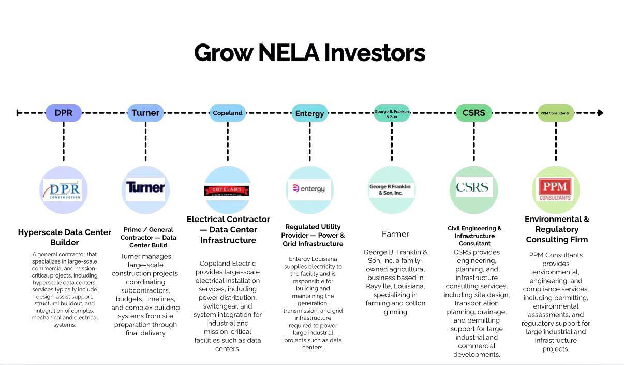
    This graphic is the first in a bonus series breaking down the structure behind the Richland Parish Data Center project.

    To be clear: this is not an accusation of wrongdoing. It is an informational overview of investors who have the closest structural proximity to the construction and infrastructure layers of the project.

    This chart focuses on companies whose industry roles align directly with large-scale industrial builds — including prime contractors, heavy civil construction, electrical infrastructure, engineering, and utility providers. These categories are typically involved in site preparation, power delivery, construction management, permitting, and systems integration.

    The purpose is to explain how large projects like this are built and which sectors are positioned within that execution ecosystem. Investor status does not automatically mean a company was awarded a contract or had decision-making authority. It simply shows financial participation in the regional economic development organization alongside industry alignment.

    As I continue reviewing public documents and awaiting responses to records requests, future charts will explore additional layers — including timeline, governance structure, and broader economic impact.

    The goal is transparency and understanding of process, not speculation.

    More information to come.

    CAN Report Image

  • Bonus Feature: The Digital Footprint (Chart 1)

    Bonus Feature: The Digital Footprint (Chart 1)

    Series: The Richland Parish Data Center: Truth, Rumor and The Record

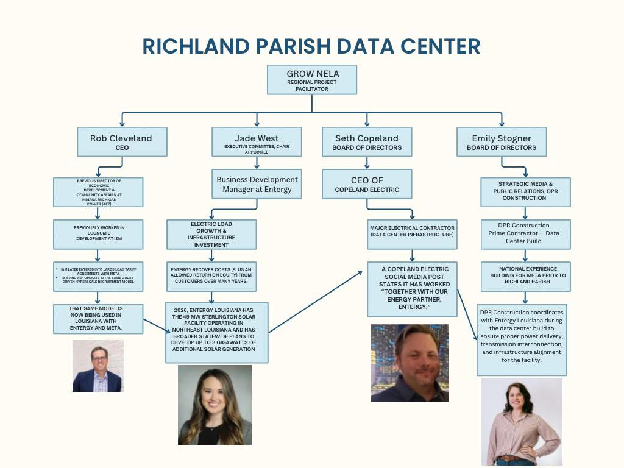
    Remember these names, remember these faces — this is one of many charts I’ll be dropping just to fill you in on the connections that deserve clarity.

    It simply maps out publicly documented roles connected to the Richland Parish Data Center: regional economic development (Grow NELA), the utility provider (Entergy), and contractors involved in the build (DPR and Copeland Electric). These kinds of projects typically move through recruitment, infrastructure planning, and regulatory approval before public announcement, often within a relatively small professional network.

    The purpose of this graphic is to show structure — not to suggest wrongdoing. Many citizens have said they felt left out of the loop, so I’m laying the groundwork to better understand how the process unfolded. I’m still waiting on public records requests, and future posts will include more documentation as it becomes available.

    CAN Report Image

  • Update: Waiting on Public Records

    Series: The Richland Parish Data Center: Truth, Rumor & The Record

    I want to address the delay in publishing the next installment of this series.

    Multiple public records requests have been submitted to local entities regarding board minutes, confidentiality agreements, legal expenditures, and related documentation connected to the Meta project. As of today, local agencies have not provided responses within the expected timeframe.

    The State of Louisiana is currently the only office that has formally acknowledged receipt of my request and is actively assisting in locating records. That process is underway.

    I have also reached out directly to several officials for comment. Mayor Friday Ellis responded and his responses were published. Shane Smiley has not responded to requests for comment as of publication. As fate would have it, I did see him in person last week at the Daily Press in Monroe. I reminded him of my requests for transparency and was told he would follow up, but I have not yet received a response. The mayor’s office in Rayville has also not returned my calls.

    In addition, individuals with legal authority have contacted me requesting meetings regarding what I have uncovered so far. I welcome open dialogue grounded in documentation. I am looking forward to these meetings.

    Let me be clear: this reporting is not driven by rumor. It is driven by records. The next article is delayed because I am waiting on documentation. Responsible reporting requires verification, not assumptions.

    This story is not being abandoned. It is being built carefully.

    Major projects leave paper trails. When those records are received and reviewed, I will publish. Taking what I’ve learned off the record and putting it into a responsible article takes time.

    I planned my timelines for publishing around the length of time public records requests operate on — lesson learned.

    Stay patient. It’s still coming.