Tag: Shane Smiley

  • The Crooked Smile of Leadership

    Ouachita Parish Leadership Under Scrutiny

    First things first:
    This is Part One of a series examining leadership and public trust in Ouachita Parish. Its purpose is not retaliation, but transparency. I am calling on local government leaders to review these concerns, evaluate Shane Smiley’s continued fitness to serve, and take appropriate action — including removal from the Ouachita Parish Police Jury if warranted.

    If meaningful action is taken to restore public trust, this series does not need to continue. If it is not, future posts will focus on documented patterns, community impact, verified claims I have uncovered, and mechanisms for accountability. The goal is simple: leadership that reflects the standards, presence, and integrity Ouachita Parish residents expect — especially in moments when the community needs it most.

    When video footage surfaced last year showing Ouachita Parish Police Jury President Shane Smiley speaking harshly and using profanity toward young female employees at his Monroe restaurant, Catahoula’s, it sparked widespread concern. Smiley apologized publicly but refused to resign, maintaining that the incident did not warrant removal from office.

    Since then, discussions and unverified rumors have circulated about workplace culture and his personal life, adding to growing public discomfort with his leadership. Multiple residents have expressed disappointment in his absence during the recent winter storm, citing a lack of visible leadership and communication during a critical time.

    During my recent investigations into Shane Smiley, I have uncovered information suggesting that his actions were not isolated and may continue to occur behind closed doors. While he remains active in official parish business, many residents feel accountability has not been fully addressed.

    Although this article primarily focuses on events from the past year, the concerns are ongoing. Sources have raised strong claims that, in my opinion, make Smiley unfit for his role as a publicly elected official.

    Citizens have noticed their inability to publicly comment on the government page representing the Police Jury and have turned to me for help. For now, I am posting limited (and already publicly circulating) information as a reminder that the public has not forgotten. In fact, they are more frustrated than ever. Echoes of citizens who feel their voices are censored and ignored sound locally, a troubling public perception considering the past issues.

    I am calling on local government leaders to review these concerns, evaluate Shane Smiley’s continued fitness to serve, and take appropriate and immediate action to remove him from his position as Police Juror.
  • The Overlap: Public Dollars, Private Influence

    The Overlap: Public Dollars, Private Influence

    This article may appear in multiple series, as the topics are intertwined.

    Economic development in Northeast Louisiana is often described as a public-private partnership. That model is common. What matters is how it functions in practice.

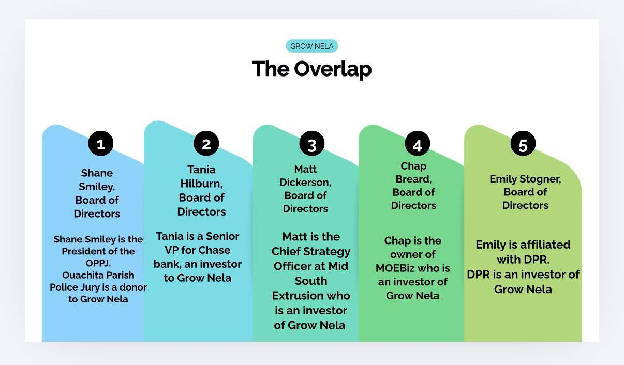
    A review of GROW NELA’s publicly listed Board of Directors and investor roster reveals a pattern of overlap between those who financially support the organization and those who help govern it.

    Documented examples include but are not limited to:
    Shane Smiley, President of the Ouachita Parish Police Jury. The Police Jury is listed as an investor in GROW NELA. Smiley also serves on GROW NELA’s Board of Directors representing the parish.
    Tania Hilburn, Senior Vice President with Chase Bank. Chase is listed as an investor in GROW NELA. She serves on the board representing the bank.
    Matt Dickerson, Chief Strategy Officer at Mid South Extrusion. Mid South Extrusion is listed as an investor in GROW NELA. He serves on the board.
    Chap Breard, owner of MOEbiz. MOEbiz is listed as an investor in GROW NELA. He serves on the board.
    Emily Stogner, affiliated with DPR Construction. DPR is listed as an investor in GROW NELA. DPR is also a prime contractor on the Meta data center project in Richland Parish.

    These connections are drawn directly from publicly available board and investor listings.

    This structure means that multiple entities financially supporting GROW NELA also hold governance positions within the organization.

    That structure is not automatically improper.

    However, when public institutions invest taxpayer dollars into an organization whose board includes private firms that may later benefit from development projects, the public has a right to review:
    – How funding agreements are structured
    – Whether conflicts of interest are disclosed
    – Whether recusals are documented
    – Whether procurement processes involving investor-linked firms are transparent

    Public Records Requests

    In order to better understand how these relationships operate in practice, I submitted public records requests to both the City of Monroe and the Ouachita Parish Police Jury seeking documentation of:
    – Contracts and cooperative agreements with GROW NELA
    – Payments to investor-linked firms
    – Procurement documentation related to those contracts

    After receiving no communication from the Police Jury, I visited their office in person. I was informed that my request was received on February 20. I requested written confirmation of receipt and was told the request had been forwarded to the Police Jury’s attorney.

    As of this writing, no records have been produced.

    Under Louisiana Public Records Law, public bodies are required to respond within three business days by either producing records or providing a written explanation and timeline.

    The State of Louisiana has acknowledged receipt of a related records request and indicated that documents are being compiled on their behalf.

    This review is ongoing.

    CAN Report Image

  • Update: Waiting on Public Records

    Series: The Richland Parish Data Center: Truth, Rumor & The Record

    I want to address the delay in publishing the next installment of this series.

    Multiple public records requests have been submitted to local entities regarding board minutes, confidentiality agreements, legal expenditures, and related documentation connected to the Meta project. As of today, local agencies have not provided responses within the expected timeframe.

    The State of Louisiana is currently the only office that has formally acknowledged receipt of my request and is actively assisting in locating records. That process is underway.

    I have also reached out directly to several officials for comment. Mayor Friday Ellis responded and his responses were published. Shane Smiley has not responded to requests for comment as of publication. As fate would have it, I did see him in person last week at the Daily Press in Monroe. I reminded him of my requests for transparency and was told he would follow up, but I have not yet received a response. The mayor’s office in Rayville has also not returned my calls.

    In addition, individuals with legal authority have contacted me requesting meetings regarding what I have uncovered so far. I welcome open dialogue grounded in documentation. I am looking forward to these meetings.

    Let me be clear: this reporting is not driven by rumor. It is driven by records. The next article is delayed because I am waiting on documentation. Responsible reporting requires verification, not assumptions.

    This story is not being abandoned. It is being built carefully.

    Major projects leave paper trails. When those records are received and reviewed, I will publish. Taking what I’ve learned off the record and putting it into a responsible article takes time.

    I planned my timelines for publishing around the length of time public records requests operate on — lesson learned.

    Stay patient. It’s still coming.

  • Part 6 — The Local Layer (1 of 2): What We Know Now

    Series: The Richland Parish Data Center: Truth, Rumor & The Record

    As I continue examining the local layer behind the arrival of Meta to northeast Louisiana, I want to begin by clearly separating what is documented and confirmed from what remains under review.

    Major projects like this do not move forward through corporations alone. They move through regional boards, nonprofits, utilities, chambers of commerce, and public officials who operate much closer to home. Understanding that local layer is essential.

    Confirmed Board Overlap

    Public nonprofit filings show that both Friday Ellis and Shane Smiley served on the board of Grow NELA during the period when the Meta data center was being promoted. Grow NELA later transitioned into Grow Northeast Louisiana, with overlapping leadership involved in that restructuring.

    It is also documented that during this period, the nonprofit reported significant legal and consulting expenditures and later transferred assets as part of its transition.

    Those facts are not allegations. They are contained in publicly filed nonprofit documents.

    Entergy Representation

    Board listings also show representation connected to Entergy, the regional electric utility. That is not unusual for economic development organizations. Utilities frequently sit on regional boards because infrastructure and power commitments are central to industrial recruitment.

    However, it is a relevant structural detail given that hyperscale data centers like Meta’s are heavily dependent on long-term power agreements and grid capacity planning.

    Richland Parish Chamber Overlap

    There is also documented overlap between Grow NELA board membership and the Richland Parish Chamber of Commerce. Chamber leadership participation in regional development boards is common, but it is part of the broader ecosystem that shaped regional economic strategy during the same timeframe.

    These overlapping roles do not imply wrongdoing. They do, however, illustrate how interconnected regional leadership can be during major project development.

    Direct Questions to Local Officials

    Because of public speculation surrounding non-disclosure agreements and local involvement, I reached out directly to Mayor Ellis and to Shane Smiley for comment and clarification on the rumors circling.

    Mayor Ellis responded.

    In his response, he stated that he did not personally sign any non-disclosure agreement related to Meta, site selection, or economic development discussions. He also stated that the City of Monroe did not sign any non-disclosure agreements related to the project.

    Ellis acknowledged that confidentiality agreements are common during early site evaluation processes but stated that any such agreements would have been handled at the organizational level and that he was not a signatory.

    He further stated that he did not participate in Meta site selection negotiations and was not involved in Meta-related discussions at either the city level or within the nonprofit. He described his board role as general governance and regional economic development strategy rather than project-level negotiation.

    As of publication, Shane Smiley has not responded to a request for comment regarding the same questions.

    I also reached out to the Mayor of Rayville for comment. That call has not been returned.

    What Happens Next

    Public records requests have been submitted seeking:
    – Board meeting minutes
    – Confidentiality agreements
    – Legal expenditure documentation

    Those records are pending.

    Part Two of The Local Layer will move beyond board structure and governance and examine another critical piece of the story: how the land for the Meta project was acquired and what can be expected moving forward in terms of land purchasing, development expansion, and regional real estate impact.

    When projects of this scale arrive, the story is not just about a corporation. It is about the network of local leadership, institutions, infrastructure partners, and property decisions that shape what happens next.

    This first installment focuses on what is documented and confirmed.

    The next will examine the land, the transactions, what they may signal about the future and what the pending records can confirm.